TapRacer
About the Game
A word from the developer
Bet you never asked yourself: why this game? Well, I'm telling you anyway. Back in the day I loved games like Summer Games from 1984, where you had to waggle your joystick left and right as fast as humanly possible to be first across the line. The joysticks didn't last long. The fun lasted a whole lot longer.
Problem was: animating running bodies with zero 3D experience? They'd barely look better than they did in 1984. But spinning a couple of tires, how hard can that be?
During development, all those made-up numbers, factors and values bugged me more and more. In early versions, the force came from a flat 9,000 newtons, and horsepower was a multiplier called "Power" with a value of 1.0. Air resistance came at a flat rate of 0.40, and rolling resistance was 200 newtons whether the car weighed one metric ton or three. A perfect launch gifted the car 6 m/s, just like that. Nail a shift and you got 25% more force for 0.6 seconds, as if the engine enjoyed a bit of praise. Cold tires had 80% grip, got better in a dead-straight line up to 70 °C, and at 130 °C were exactly as bad as cold ones again. And later on, tuning parts weren't parts at all, just factors: "×1.45" sat in the code where today there's a real part with real torque.
I couldn't stand it. My passion for cars, and my perfectionism about things that matter to me, are simply too big for that.
Rabbit hole number one, absurdly deep: let's just build the entire simulation on real physics! I had to learn a ridiculous number of formulas and laws, many of which I'd never even heard of. For example:
- Wheel force: engine torque × gear ratio × final drive × efficiency ÷ wheel radius
- Aerodynamic drag ½·ρ·Cd·A·v², with air density worked out from air pressure and temperature
- Rolling resistance per tire type
- Grip via Pacejka's "Magic Formula", the tire model real vehicle engineers use
- Weight transfer: under acceleration the car squats onto its rear axle (m·a·h ÷ wheelbase), which is why rear-wheel drive launches better
- The engine as an actual spinning mass with inertia, the clutch slipping according to Coulomb friction
- Tire temperature in three layers with heat conduction, airflow cooling and thermal radiation per Stefan–Boltzmann. How temperature shifts grip is described by an Arrhenius law from rubber physics (Persson 2015).
- Tire blowouts from accumulated heat damage, engine failure from heat balance and time spent on the rev limiter
- Timing like on a real drag strip: the clock only starts once the front tire clears the light beam. How far the car has already rolled by then depends on the tire diameter.
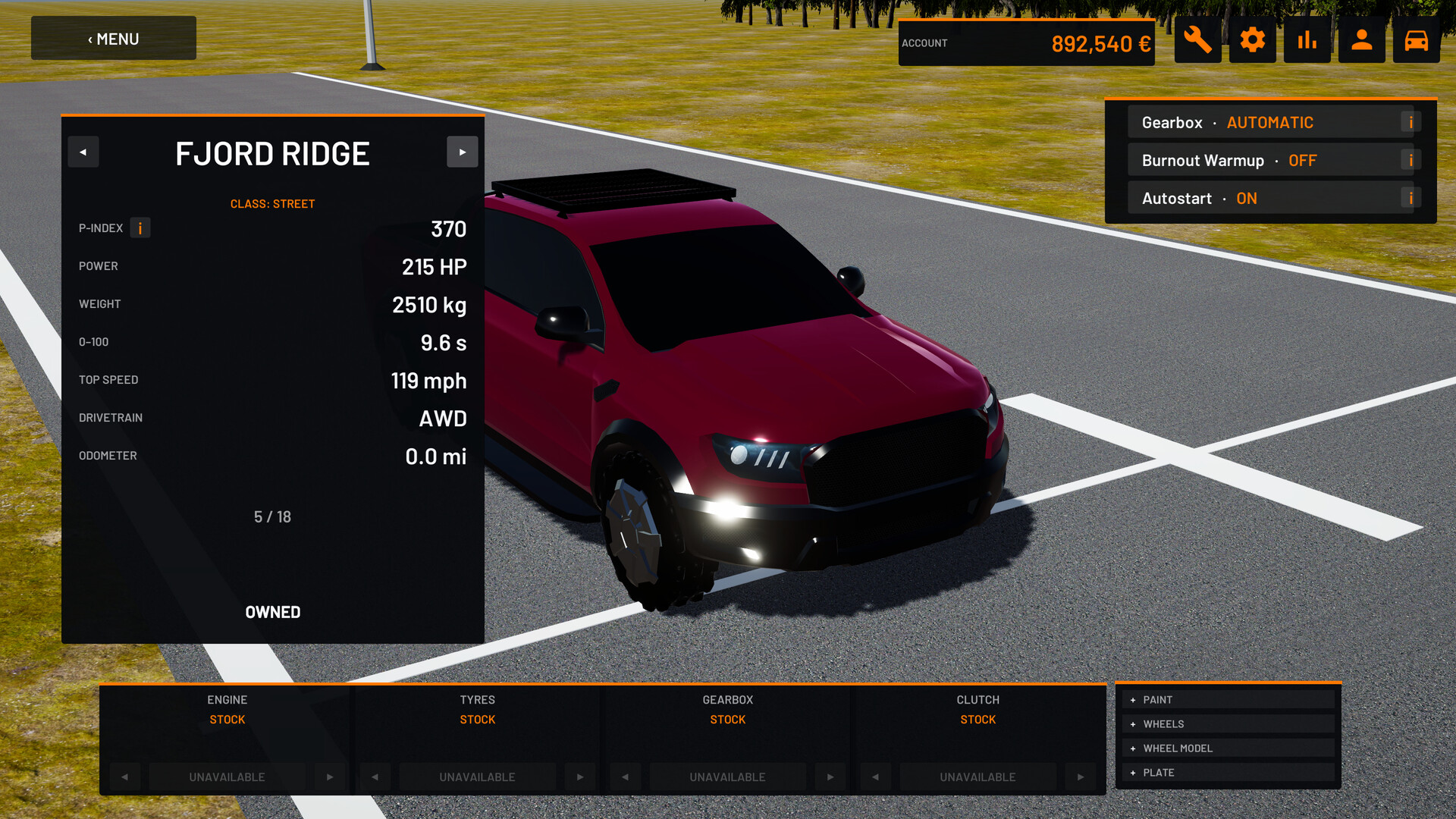
Next up, cars modeled on real-world vehicles obviously needed real data. Rabbit hole number two, even deeper: the research. Power and torque with their rpm, idle and rev limiter, engine layout and aspiration, every single gear ratio, final drive, transmission type (manual, torque-converter automatic), drivetrain including AWD torque split, weight, weight distribution, wheelbase, center-of-gravity height, drag coefficient, frontal area, tire width and diameter, rim size, clutch capacity, top-speed limiter, traction control yes/no. And for cross-checking: factory 0–100 km/h figures and real quarter-mile times with trap speeds.
And if you tune those cars, the parts obviously have to be ones that actually fit the real-world cars, at realistic prices (rabbit hole number three).
So, what have we got?
- A game whose graphics are, to put it kindly, a work in progress.
- A game where, with the right motivation, you can absolutely wreck keyboards, buttons and the like.
- A game that, thanks to realistic driving physics and simple tapping as your throttle, is easy to learn, really hard to master, and on top of that, ridiculously fun!
This is only the start of what I hope will be a long journey. And if there are a few people out there who enjoy this game as much as I do: I've got a roadmap that would keep me busy full-time for three years.
This is my first game, and I read all the feedback. If something feels wrong, tell me, that's exactly what the demo is for. Have fun!
About the Game
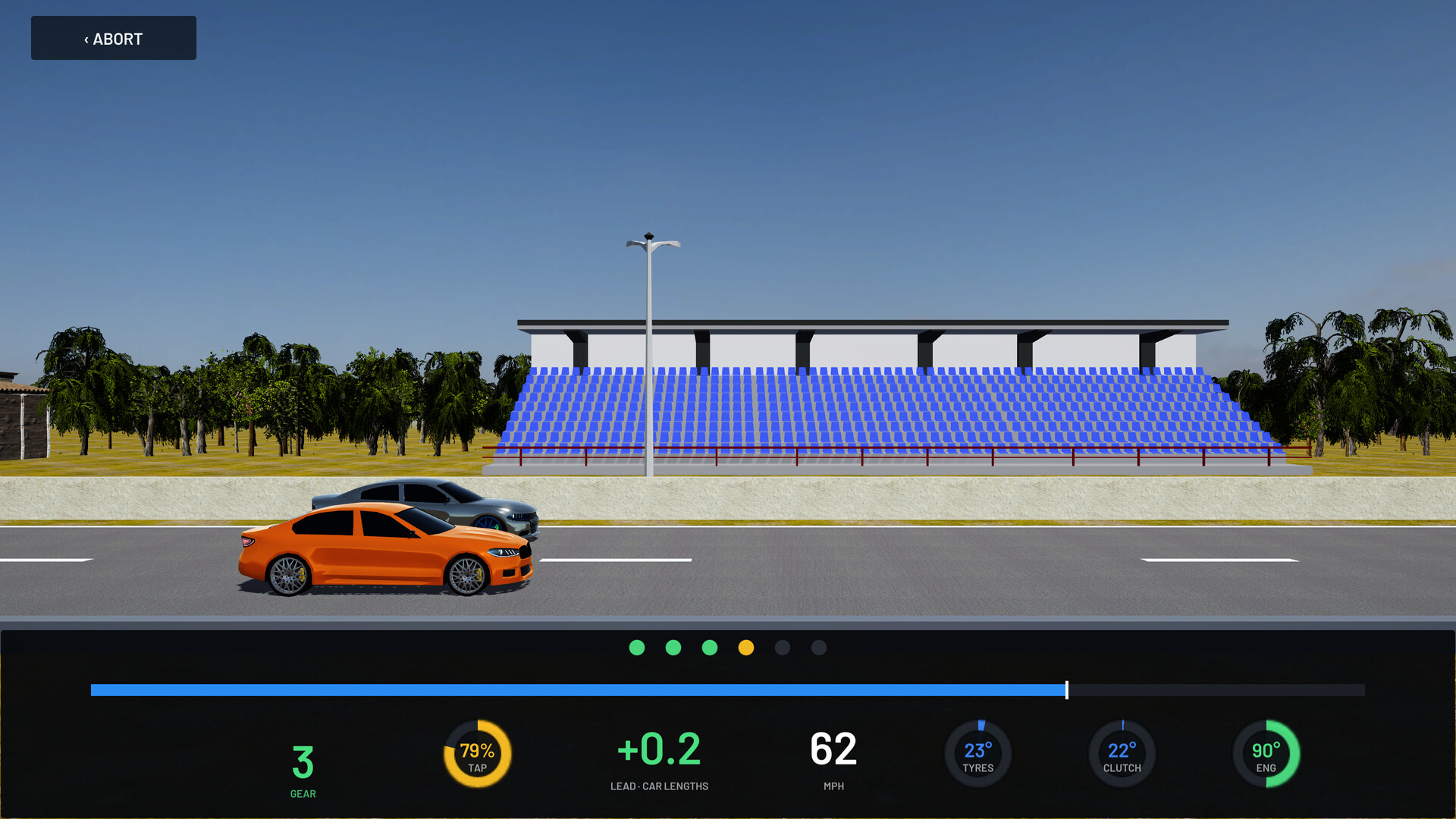
Two keys. A quarter mile. No room for error.
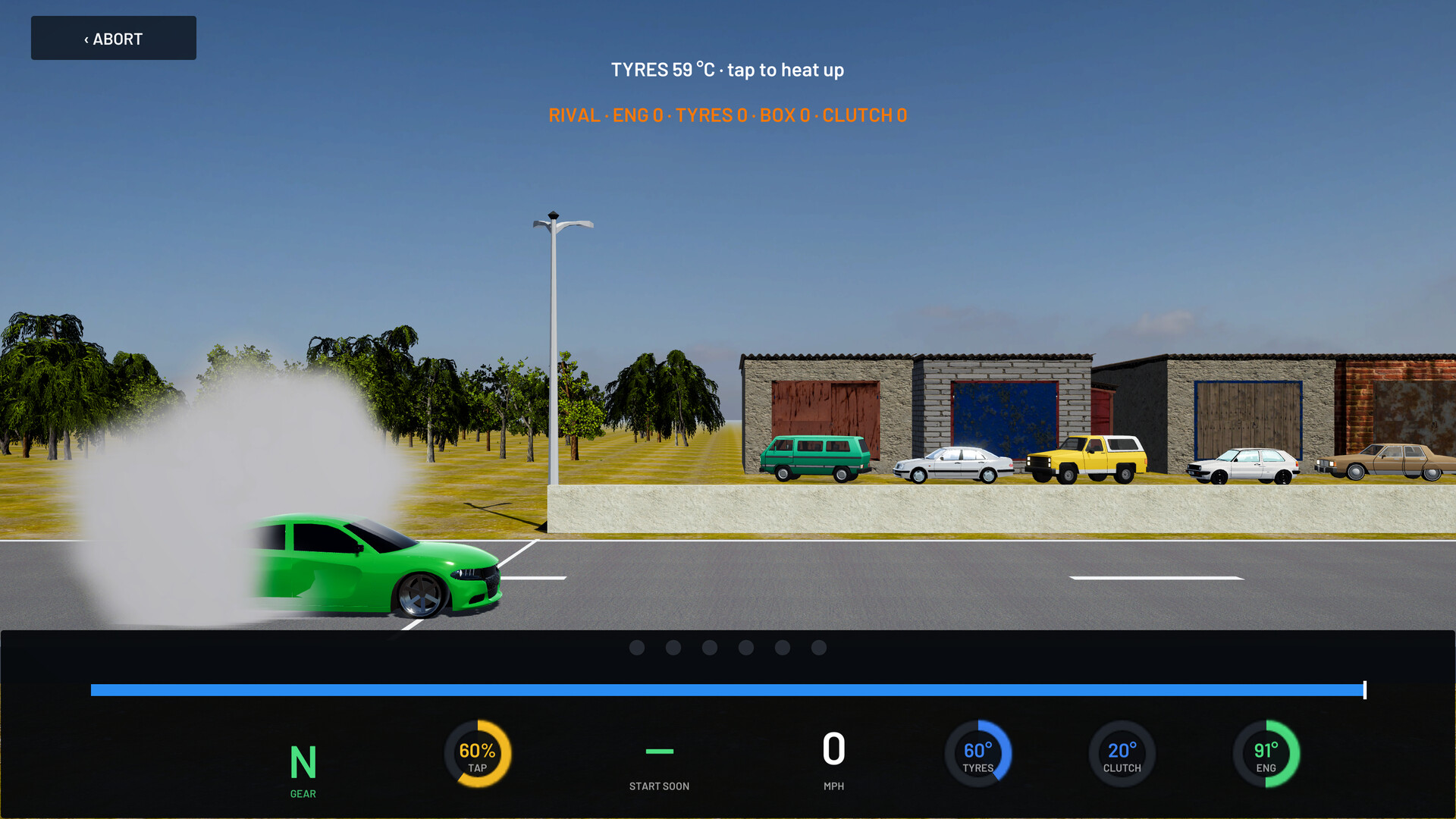
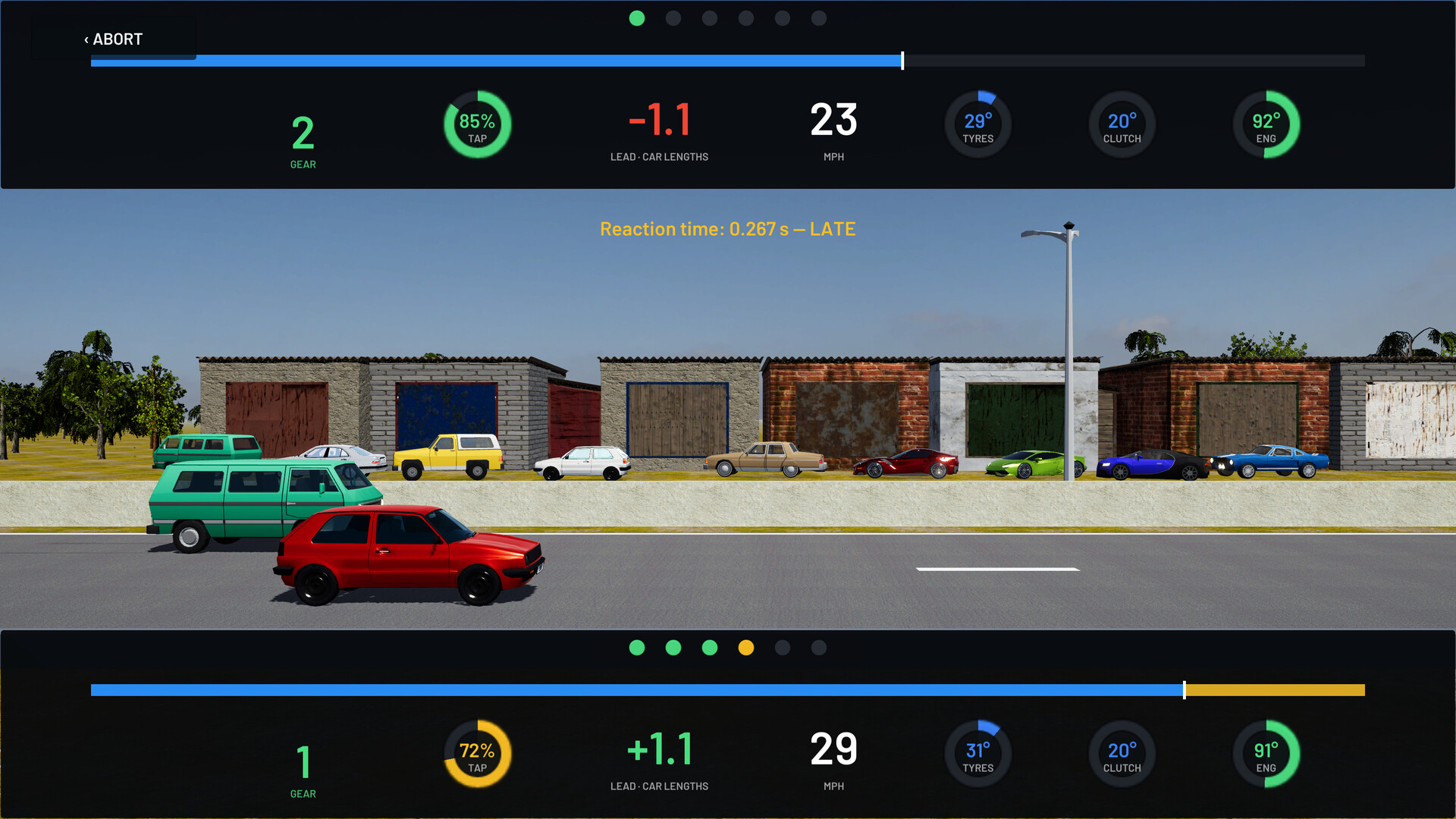
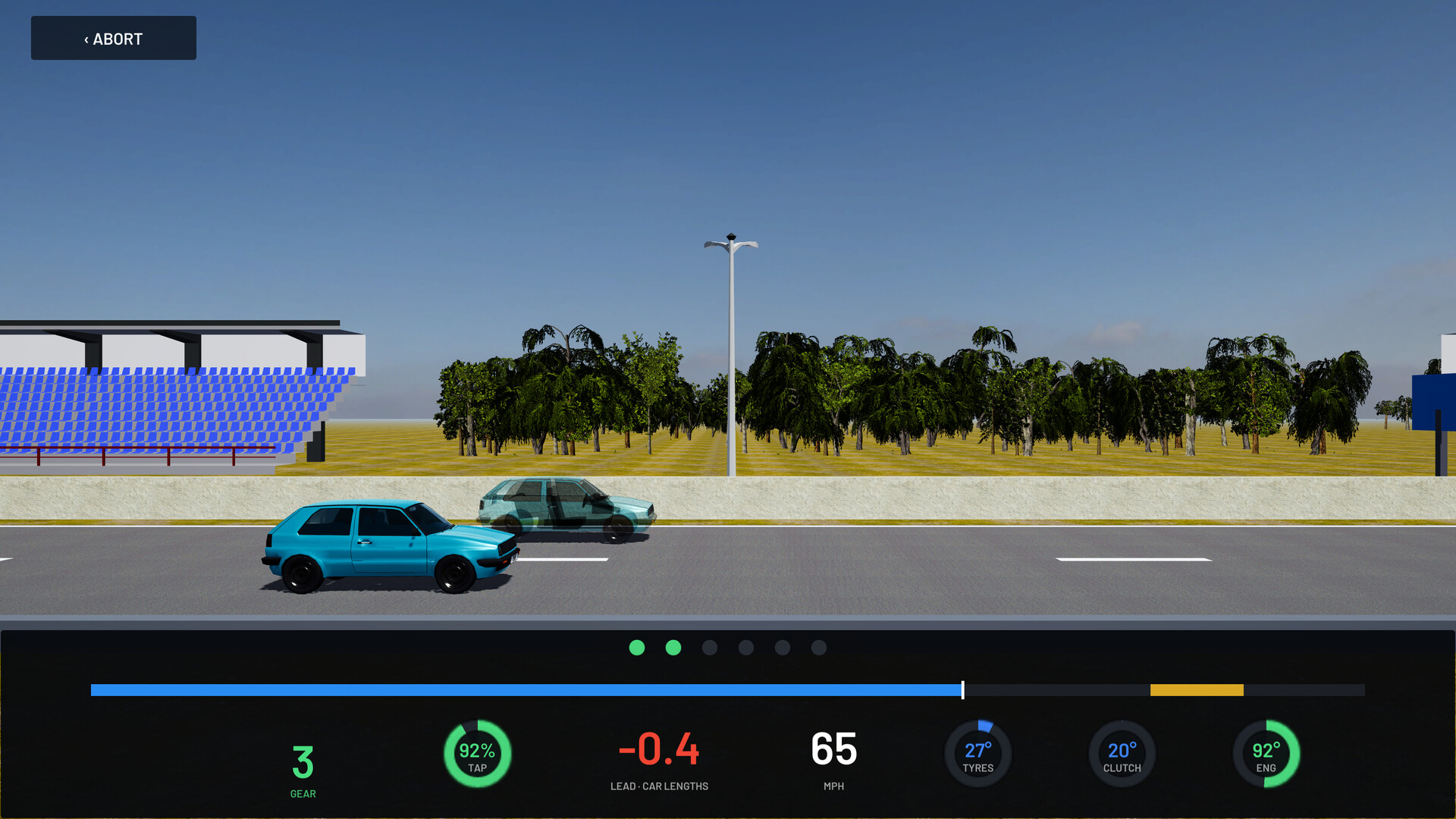
TapRacer is a side-on drag racing game. You tap two keys in strict alternation — that's your throttle. How fast you tap sets the revs. What comes of them is up to the car.One race, four decisions
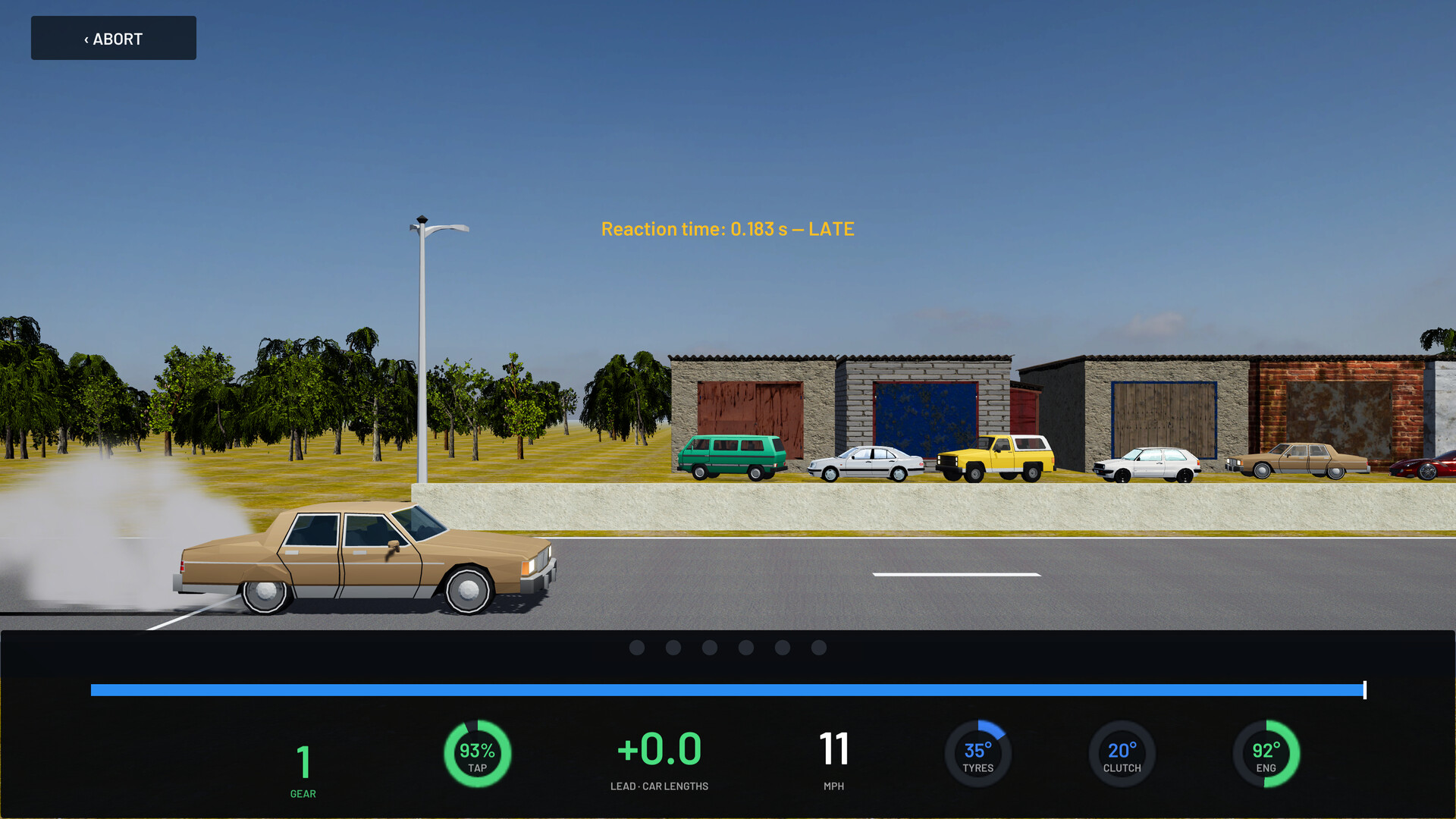
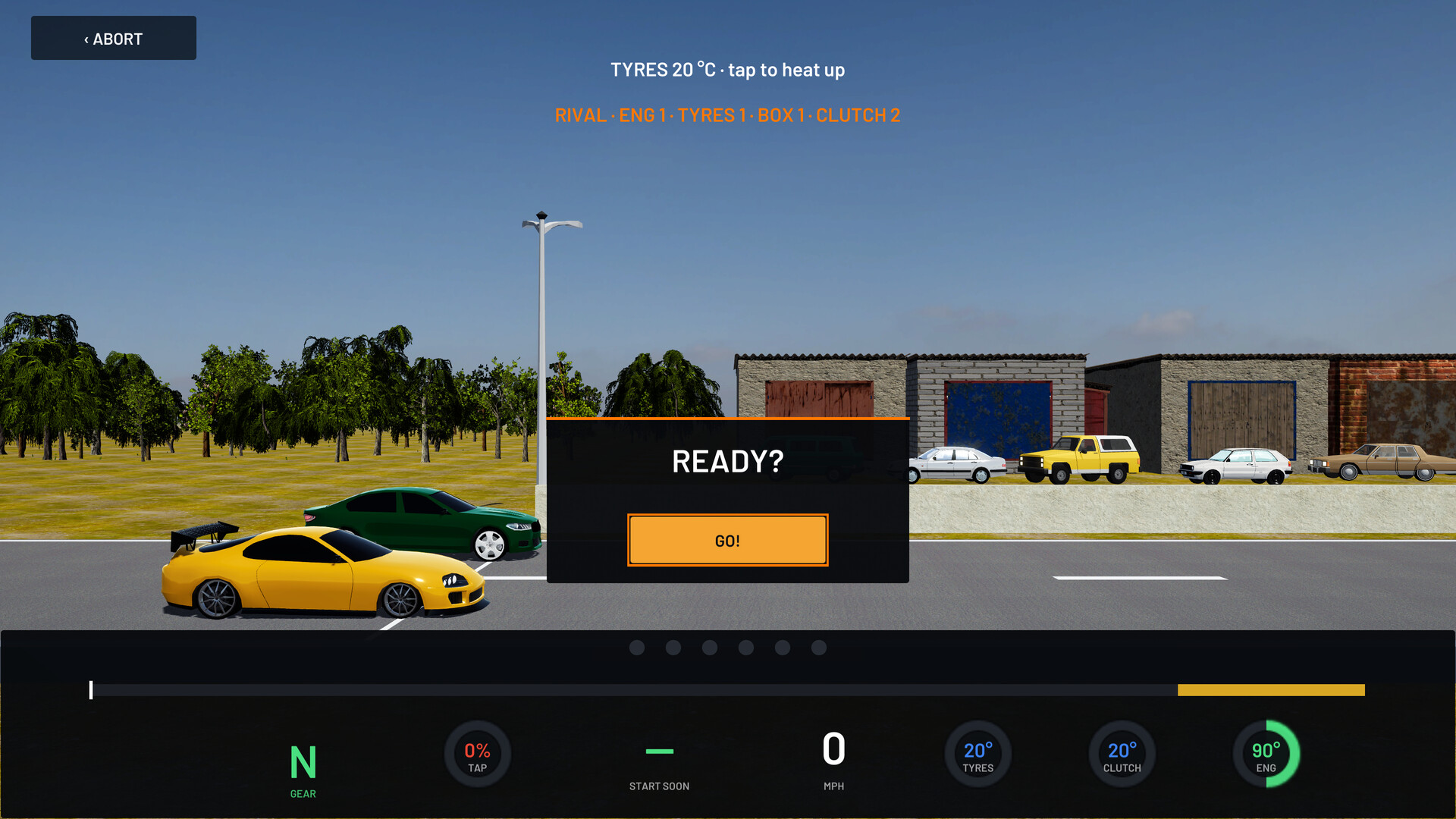
Burnout. Cold tires are bad tires. Spin them up on the line until they're in the window — too little and you'll light them up off the start, too long and the rubber — or the engine — gives up.Launch. The clutch drops on a button press. Too few revs and the engine bogs; too many and the wheels break loose. The perfect start lives in between. Reaction time counts, and jumping the lights loses you the race outright.
Shifting. The window sits just short of the red. Hit it and you keep everything. Early and it lugs, late and the limiter eats your time. If that's one thing too many, take the automatic — safe, never perfect.
Tapping. All the way, green to stripe. Easing off shows up immediately.
Cars that drive their spec sheet
No abstract stat bars. Every vehicle has a real torque curve, real gear ratios, mass, drag and rolling resistance. The clutch slips, the rear axle squats under power, the tires heat up and cool back down. The better car wins between equal drivers — but frantic tapping keeps a worse one in the fight for a surprisingly long time.A workshop, not a storefront
Earn money on the strip and put it into engine, tires, gearbox and clutch. Parts wear when you abuse them — over-revved engines, burnt clutches, blown tires. The service bay is waiting.Someone is always faster
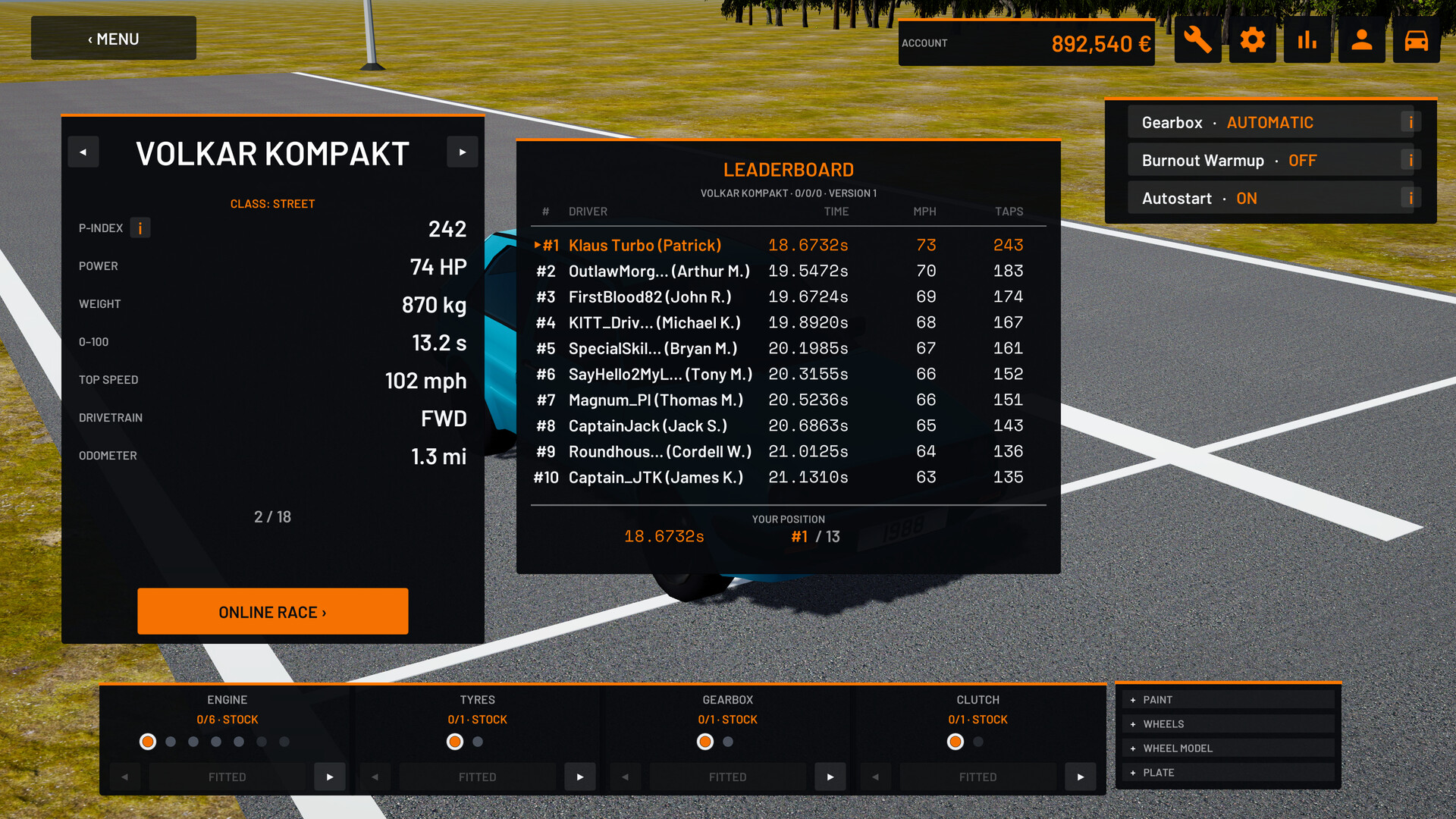
A career against a climbing field. Daily challenges. Online leaderboards where you chase the leader's ghost. A LAN duel against the machine in the next room. Or two players on one keyboard.None of it is for sale. No microtransactions, no ads, no shortcuts.
Features
- Two-key control with strict alternation — your tapping rate is the throttle
- Real longitudinal dynamics: torque map, engine inertia, clutch slip, traction limit
- Tire temperature with burnout warm-up
- Weight transfer — rear-wheel drive launches nothing like front-wheel drive
- Manual shifting with a timing window, or automatic for the safe way round
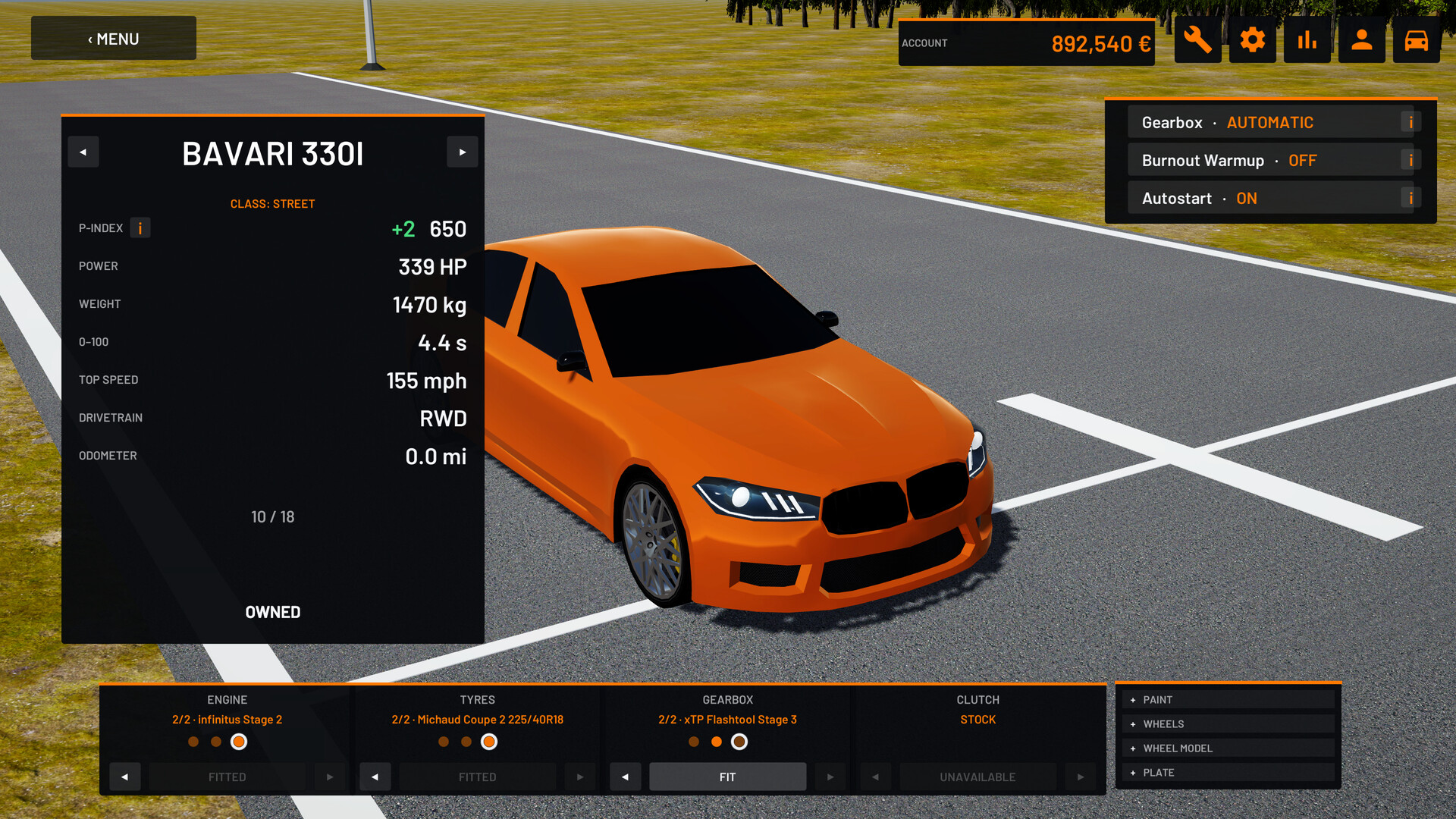
- 18 vehicles across several classes, all earned in game
- Real aftermarket parts for engine, tires, gearbox and clutch — the shop only stocks what actually exists for that car
- Part wear and mechanical failures when you push too hard
- Career, quick race with a wager, time trial against your own ghost
- Online leaderboards and daily challenges
- LAN duel and two-player on a single keyboard
- English and German
Available Tables (0)
View available tables...Events Timeline
View full events timeline...Initial Release