Space Tanks

About the Game
Space Tanks
A tactical retro artillery game on small planets – challenging, skill-based, and deliberately different.
When YawThrust Software Labs developed Space Tanks, the goal was not to follow any trends. We wanted to make a game we ourselves would enjoy playing: unusual, direct, physics-based, and with far more depth than you might expect at first glance.
Gameplay
Space Tanks is not a game of chance.
Every shot is based on skill, judgment, gravity and timing – similar to golf.
If you miss, you aimed badly – you were not simply unlucky.
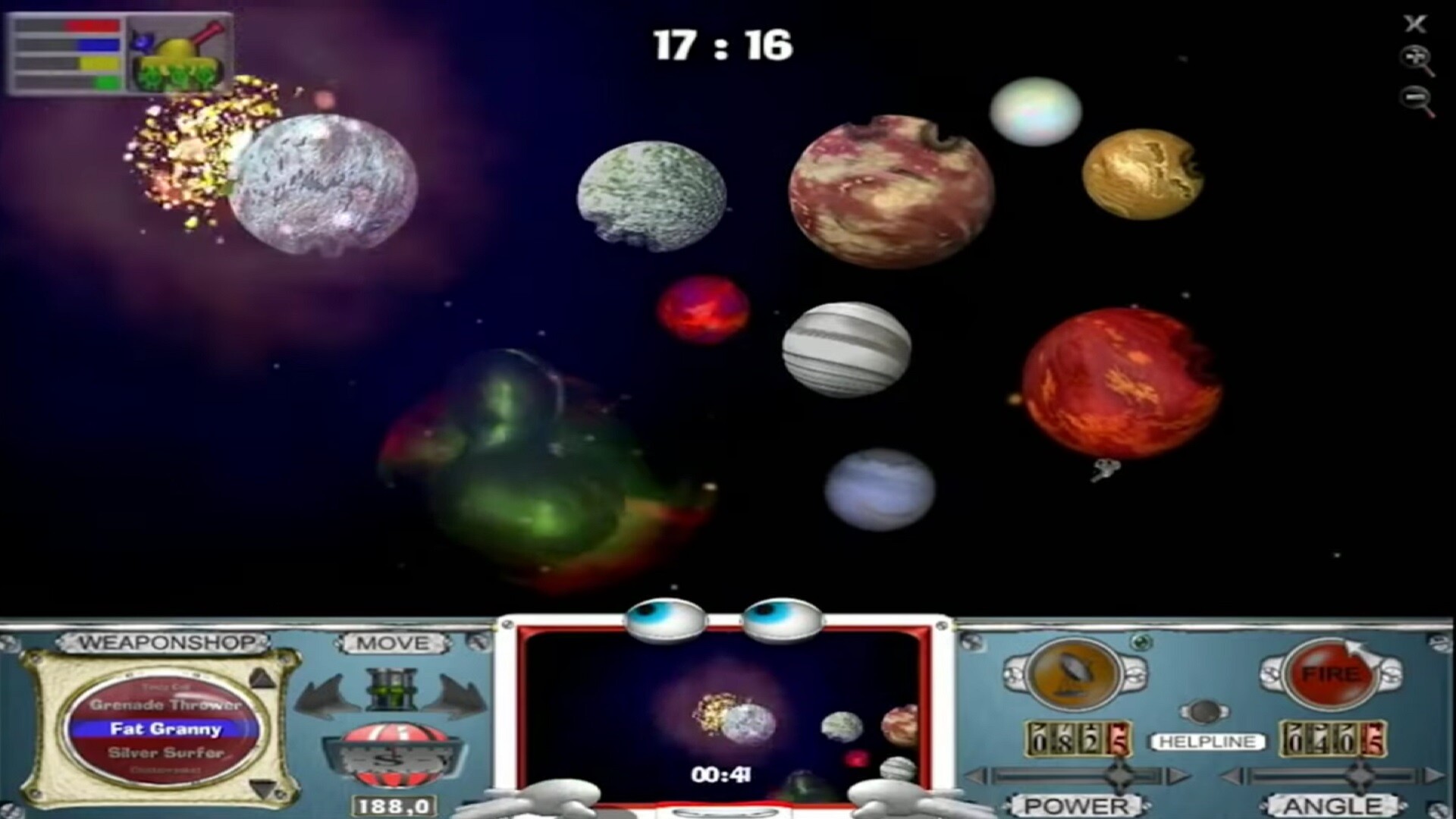
Weapon trajectories differ depending on whether you use a projectile, rocket or homing missile. Planets, moons and black holes influence them through gravity, while antigravity can even repel them.
With the freely movable mouse cursor, you control, among other things:
Weapon selection
Aim direction
Launch angle, power, or – for rockets – fuel.
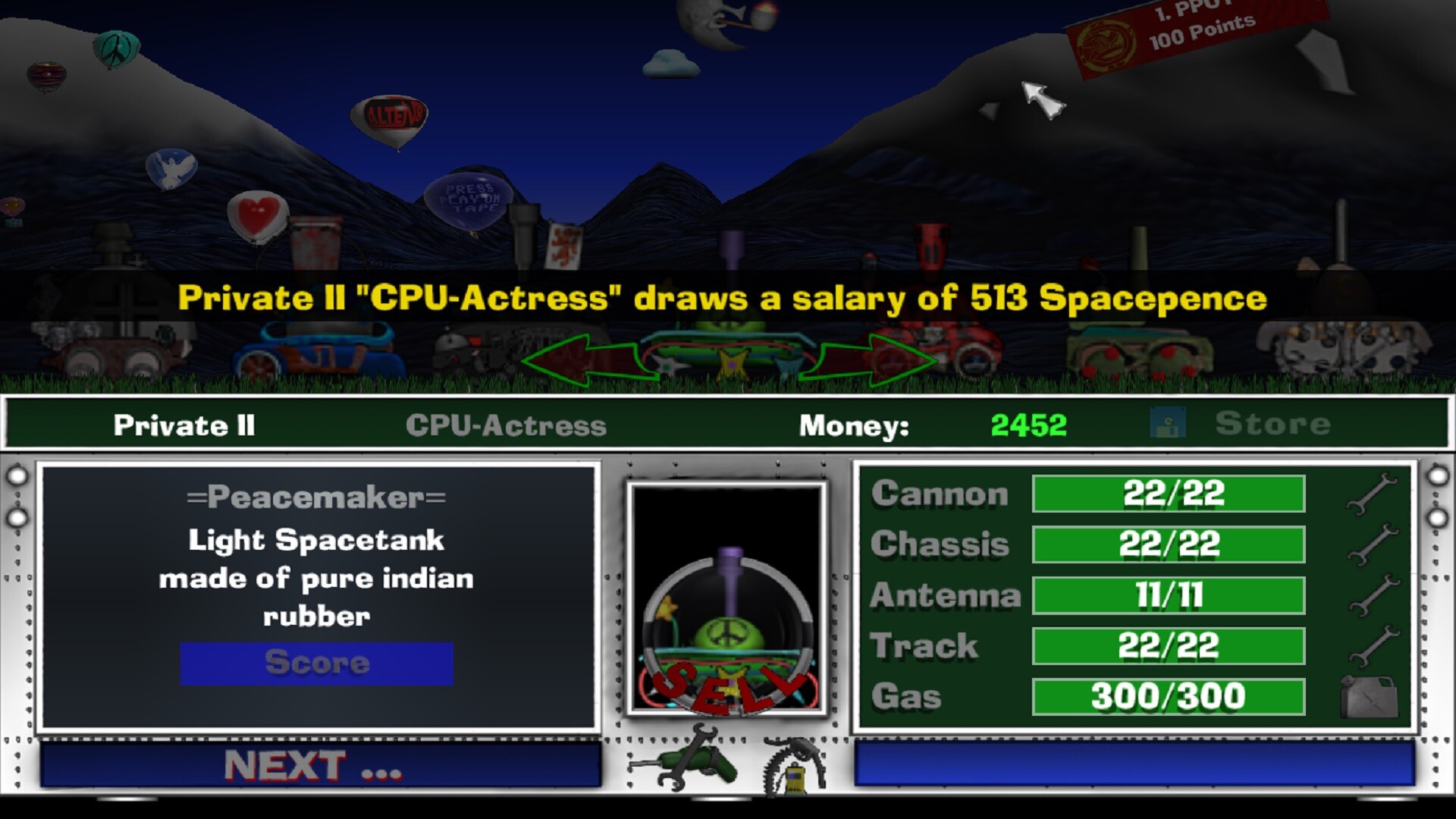
Shop and inventory
Special actions
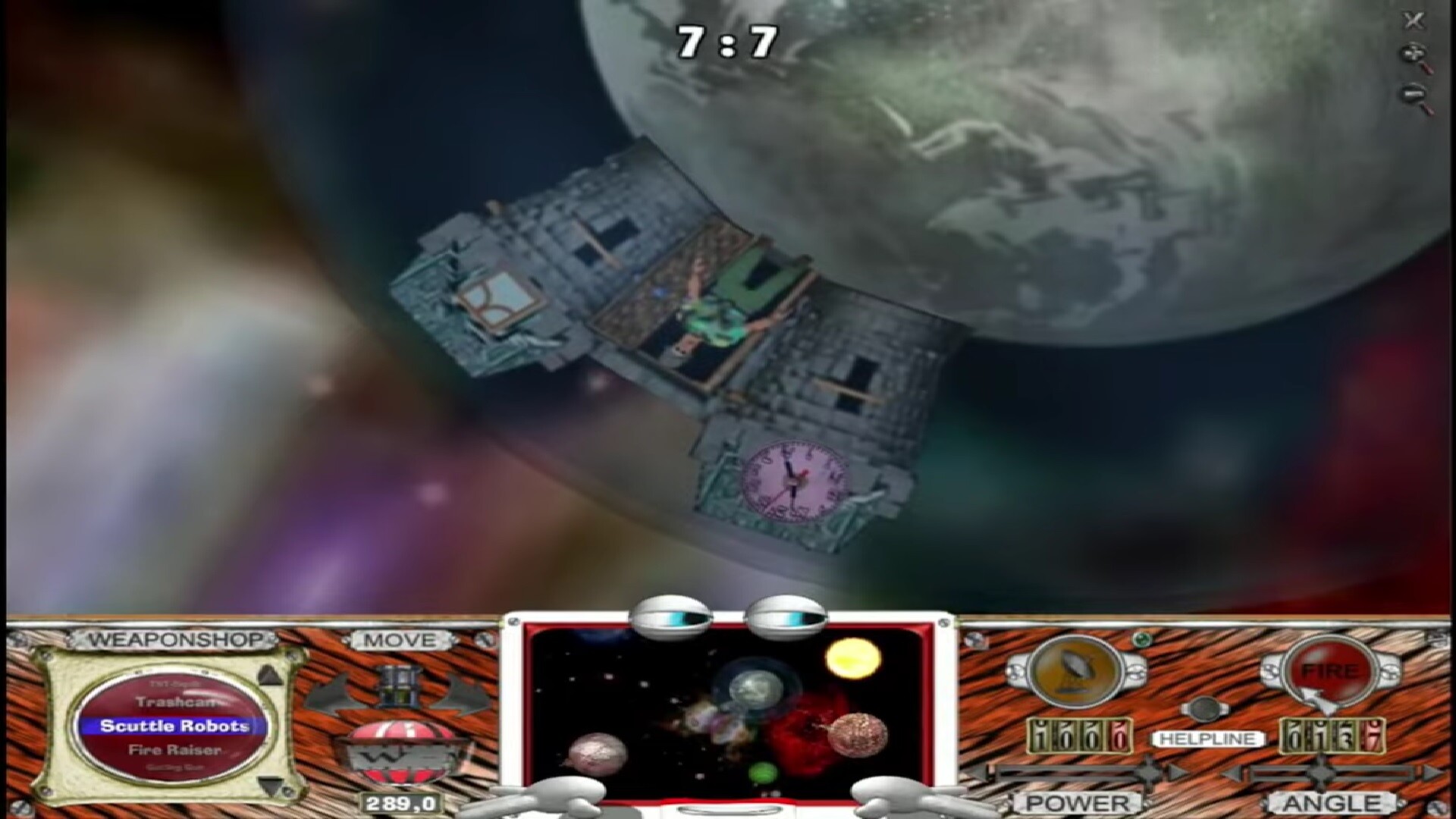
Move the mouse over planets or other elements and the small monitor at the bottom shows what you are dealing with – for example a planet, antigravity or a black hole – including its mass and whether a planet is unstable.
The weapons are divided into three classes:
Blue = Projectiles
Orange = Homing missiles
Yellow = Rockets
Each weapon class has different flight behavior and requires its own tactical approach.
Some weapons also have remote detonation.
However, this only works as long as your tank’s antenna is still intact.
If the antenna is damaged or destroyed, remote detonation is gone – and you have to live with whatever you already fired.
The aiming guide helps beginners, but costs Score and slows down your Ranking. With the right cheat code as Playername, it becomes extremely long – ideal when your opponent is not looking or has gone to get a beer. ;-)
Space Tanks remembers what you do. If you mess up – for example by shooting the janitor or using aiming guides too often – it is recorded in the savegame and taken into account in the scoring. Good actions count too: a “Hole in One”, for example, has a clearly positive effect. After all, Space Tanks is no pony farm.
If your opponent has hit you once, you should change position – otherwise they can leave the angle and Shotpower unchanged and hit you again, if necessary with a stronger weapon – as long as no moons or moving obstacles such as asteroids, aliens or other objects change the conditions.
So using your brain a little does not hurt.
If you simply start blasting away wildly, you will quickly discover that gravity, timing and strategy can shoot back too.
Deterministic Trajectories
The trajectories are deterministic.
If angle, Shotpower, weapon type and all other conditions remain unchanged, a projectile will follow the same trajectory again.
Of course, the trajectory changes when the conditions change – for example if your tank’s chassis is shot up and the tank sinks lower as a result, if you switch weapon class, or if moons change position and slightly shift the gravity.
That means:
Shots can be learned and reproduced.
Once you understand the system, you can repeat successful trajectories and become more precise with every round.
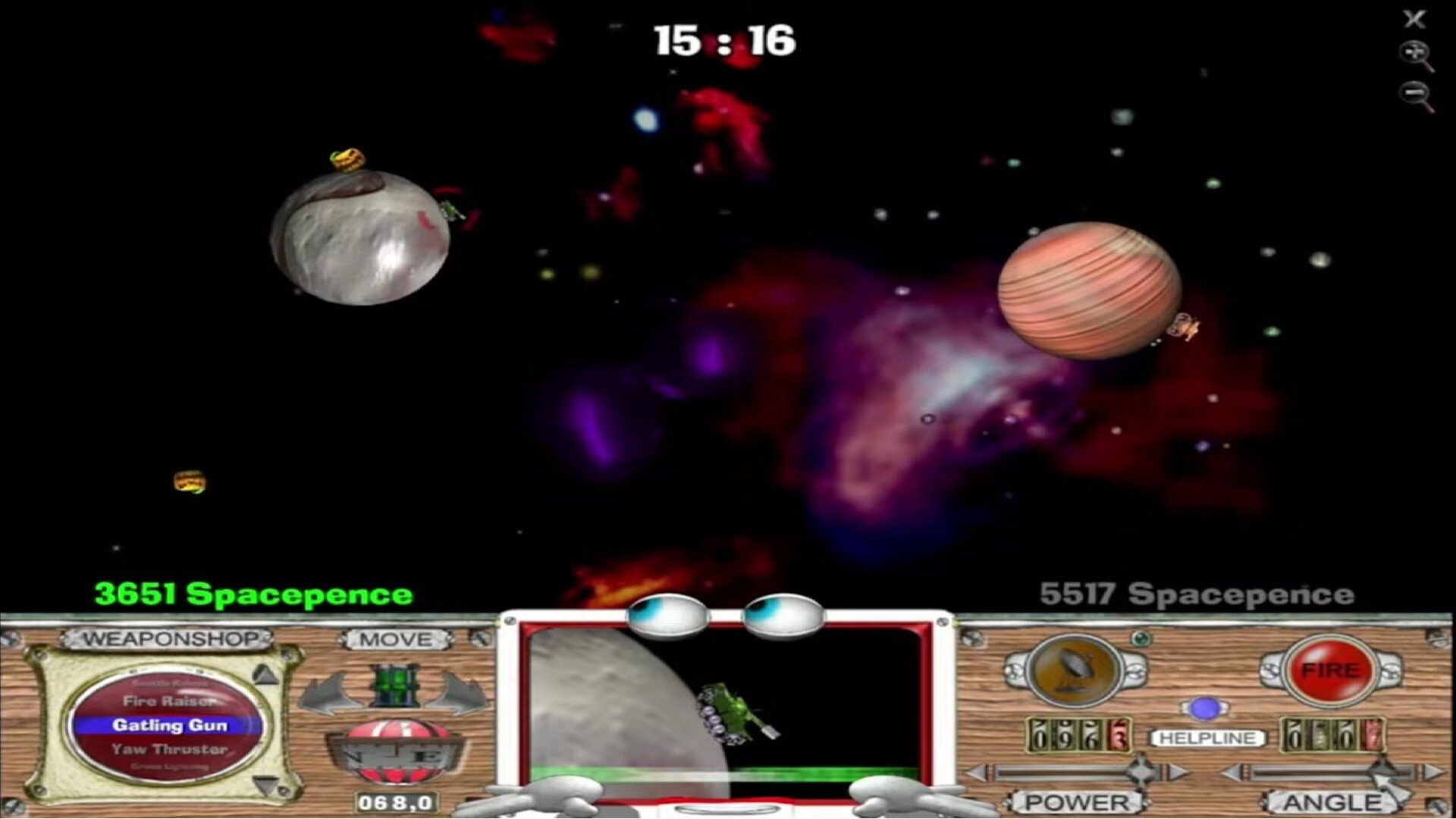
And do not forget to zoom out briefly before firing and check what may still be moving in orbit farther out – especially in later rounds, for example Space Pumpkins.
Just because you cannot see something does not mean there is nothing out there in Space Tanks.
Not a Normal Turn-Based Game
Space Tanks is turn-based, but the world does not wait for you.
Independent objects and events continue – even when it is not your turn.
Everything has a life of its own: Space Pumpkins, asteroids, debris or tank parts continue moving independently of the turns, collide and interact even outside the visible area. Space Pumpkins can lie on planets or orbit in the hundreds and, after being hit, crash somewhere much later.
If you select the coconut as a weapon, you can use it to plant palm trees on planets with an atmosphere. They slowly spread there, can catch fire and damage opponents nearby.
Mines can trigger chain reactions when exploding mines hit others.
You can recognize unstable planets by the bubbling lava in their craters. Bombard them hard enough and you can make the entire planet explode.
Aliens and Space Wasps fly through the battlefield and attack if you accidentally hit them.
Just like in real life: try, observe, learn. So do not be afraid – experiment.
As a result, things can suddenly become quite stressful and you may have to react quickly – if you are lucky enough to be the player whose turn it is.
The simulation also continues outside the visible screen area.
This means that a piece shot off the opponent’s tank – for example the antenna – may come back minutes later and fall directly “on your head”.
Even a match that already looks safely won can completely turn around in the final seconds – and may even end in a draw.
Everything can affect everything.
Settings for Hardcore Freaks
Many game parameters can be adjusted, including:
Weapon timeout
Battlefield size
Flight times
Additional weapon parameters
Additional gameplay parameters
If you really want to take it too far, you can even set the weapon timeout to 10 minutes.
Economy & Strategy
You manage a budget for:
New tanks
Repairs
Ammunition
Special weapons
Whoever wins earns money – but if you spend carelessly, you may pay dearly for it later.
If you do not immediately blow everything in the Tank Shop and instead save strategically, you will notice from around round 10 how much the tactical possibilities expand.
So it is not only about landing the next shot.
Long-term decisions matter too.
Difficulty and Chaos
A higher difficulty does not simply mean stronger opponents.
Among other things, you may encounter:
More complex planetary scenarios
Space Pumpkins
Space Wasps
Nasty Space Ships
Aliens
Palm trees and spreading fire
Mines and chain reactions
Antigravity
Black holes
Moons and additional gravitational influences
Unusual weapons
Increasingly complex trajectories and interactions
Especially in two-player mode, this can lead to some pretty strange situations.
AI Opponent
The AI opponent is not only artificially intelligent, but also artificially human: you can unsettle it, provoke it or make it angry – and even get it to copy your playstyle.
Features
Turn-based artillery action
Precise gravity simulation
Deterministic trajectories
More than 30 weapons
Three different weapon classes
Remote detonation on selected weapons
Remote functions dependent on the tank antenna
Numerous tank types
30 ranks
AI opponent and multiplayer
Physics calculations outside the visible screen area
Independent objects and events continue even outside your own turn
Continuously simulated collisions, debris and trajectories
Black holes and antigravity
Moons and complex planetary scenarios
Adjustable weapon timeout
Adjustable battlefield size
Adjustable weapon and flight parameters
Tank Shop, inventory and budget system
Long-term strategy across many rounds
History & Press
Space Tanks was released in 2003, published internationally, and remains available today — now also on Steam.
The game belongs to the classic artillery genre and follows in the tradition of titles such as Worms, Artillery Duel, and Scorched Earth.
Even back then, Space Tanks clearly divided opinion.
PC Action gave Space Tanks 30% – in retrospect, almost a badge of honor. If you do not read the Manual and just start blasting away, you can quickly mistake the trajectories for randomness.
Other publications recognized the opposite: the trajectories are not random, but learnable – like golf. That is exactly where the fun comes from: judging, learning, hitting – and sometimes enjoying a little Schadenfreude.
Computer Bild Spiele rated Space Tanks in issue 11/2003 with an overall score of 2.02 (“good”) and awarded its price-performance ratio the top rating. That made Space Tanks the best overall offer in the entire issue.
c’t awarded its highest rating [++] for long-term fun in August 2003 and wrote that even after dozens of duels, there was no lack of variety. For two opponents at one PC, there was “currently no alternative to Spacetanks”.
Space Tanks was also positively received in “Spiel- & Lernsoftware – pädagogisch beurteilt” (“Games & Learning Software – Pedagogically Assessed”) and classified as “pädagogisch wertvoll” (“educationally valuable”) – among other things because children and young people can playfully develop a feel for physics, gravity, trajectories and cause and effect.
Retro Gamer (UK) later highlighted the two-player mode in particular and described it as “immense fun”.
Looking back, these very different reactions actually fit Space Tanks quite well:
Space Tanks was never meant to be fully understood after five minutes.
If you only try the game briefly, you may initially see chaos.
If you spend more time with it, you recognize the system behind it.
A Retro Game with History
Over the years, Space Tanks has also found many fans internationally.
Many players still associate the game with their youth and remember the small planets, the weapons, the unusual trajectories and the completely absurd situations that could arise during a match.
For some players, Space Tanks is therefore not simply some old game – but a piece of their own youth.
Over the years, Space Tanks has also repeatedly been picked up and reinterpreted – even in technical implementations using MATLAB.
The version here on Steam is the original Space Tanks from 2003.
There was also a later independent Nintendo Switch game that was originally released under the name Space Tanks.
That game had nothing to do with the original Space Tanks by YawThrust Software Labs.
After the naming issue, that game was later renamed SpaceTank.
And that original character of the original is exactly what should be preserved.
Space Tanks should remain Space Tanks.
That is why, for example, you cannot simply cancel a weapon after firing it just because you suddenly think:
“Yeah … this isn’t going to work.”
A shot is a shot.
The weapon is on its way, the physics are running – now you have to live with the result.
Maybe the shot misses.
Maybe it comes back later.
Maybe it triggers something you did not even know existed.
No rewinding. No clicking it away.
And yes:
Even though many people think the referee is silly, he stays.
Simply because, in the heat of battle, a surprising number of players forget whose turn it actually is.
In many Space Tanks gameplay videos, sooner or later the same thing happens:
Someone lets out a heartfelt
“SHIT GAME!”
– and then keeps playing anyway.
That mixture of frustration, ambition and
“Come on, one more round.”
is simply part of it.
YawThrust Software Labs wanted to develop a game that grabs you, makes you shout “SHIT GAME!” every now and then, and that you can quickly start for a round with a friend or against the AI.
Do You Dare?
Space Pumpkins. Space Wasps. Nasty Space Ships. Aliens. Antigravity. Black holes. Moons. More than 30 weapons. 30 ranks. And quite a bit more.
If you are brave enough to face all this madness:
Welcome to Space Tanks.
READ THE FU*K*NG MANUAL!
After installation, you will find the manual either in the Windows program group or directly in the Space Tanks folder under “Manual”.
And do not forget to save your game in the Tank Shop from time to time.
After around 10 rounds, things really start getting wild.
Good luck – you will need it if you really want to become Space Champ.
Available Tables (0)
View available tables...Events Timeline
View full events timeline...Initial Release