Sekigahara 1600

About the Game
■ Contact is commitment.
A unit that ends its move inside an enemy Zone of Control does not get to wait and see. It attacks. That single rule removes the safest move in most wargames - sitting still and letting the other side commit first - and it changes what every step across the map is worth.
There are no quiet flanks here. Wherever the two armies touch, a battle takes place. The real decision is therefore made earlier, in the movement phase: where you choose to make contact, and where you choose not to.
■ Fight for the line, not for the kill
Ground is taken by movement. Combat exists to push the line forward, and the opposing commander knows it. The AI is built to hold a continuous front, to seal the gaps you open, and to put its weight where the line needs it - not to farm favourable odds in a corner of the map while its centre collapses.
■ Not won or lost - how far you got
Every battle is scored on seven levels, from Decisive Victory to Total Defeat, and the two sides are not judged by the same standard. At Gettysburg the Confederates must break through in the time they have; the Union need only remain standing. Holding a hopeless position one turn longer than history did is a result the game will recognise.
■ From ancient China to the American Civil War - ten of the battlefields
・Changping, 260 BC - The battle opens on the morning Zhao Kuo led his army out of its fortifications. Zhao commands a host of 450,000, yet can move only 12 counters at a time, and fewer still - 6, then 3 - if Qin seizes the passes behind it. Bai Qi does not press the front. He sends a flying column up the northern slopes to the gate in the stone wall. The wall's palisade faces north; climb from the south, and there is no wall at all. (11 turns / 71 counters)
・Guandu, 200 - Yuan Shao has 42 counters on the map, but can move only 15 of them a turn. Every one of the five grain depots at Wuchao that Cao Cao burns takes away two more - yet burning them scores not a single point. Strike at the grain, or hold the front: this day and night turns on that one question. (13 turns / 69 counters)
・Hastings, 1066 - The English shield wall on the ridge will not easily break from the front. If it breaks, it will be because it came down the hill. Below it lies a hillock that would give the English more orders each turn - bait in plain sight for both sides. Can the Normans take the ridge before nightfall? Can the English keep their king alive and their line standing? (9 turns / 39 counters)
・Ichinotani, 1184 - The Taira fortifications face west; the cliffs and the sea were meant to guard their backs. On those cliffs wait Yoshitsune's seventy horsemen. The three surprise counters, after their first blow, move and attack a second time. The Taira, still awaiting an envoy of peace, can move only 8 of their 21 counters at the start. (9 turns / 49 counters)
・Nancy, 1477 - Five turns: the last day of Charles the Bold, Duke of Burgundy. Attacking across the stream in front doubles the defence, and there are only two ways to avoid it: the road bridge under the Burgundian guns, and a woodcutters' path through the forest. Historically the allies took the path, fell on the Burgundian flank, and finished it within the hour. (5 turns / 43 counters)
・Okehazama, 1560 - The Imagawa have 33 counters to the Oda's 16, but can move only five a turn; the Oda move everything, every turn. And Oda Nobunaga has a way to win that has nothing to do with the score: destroy the Imagawa Yoshimoto counter, and the battle is over at once. Can he close the road behind Yoshimoto before Yoshimoto withdraws? (9 turns / 49 counters)
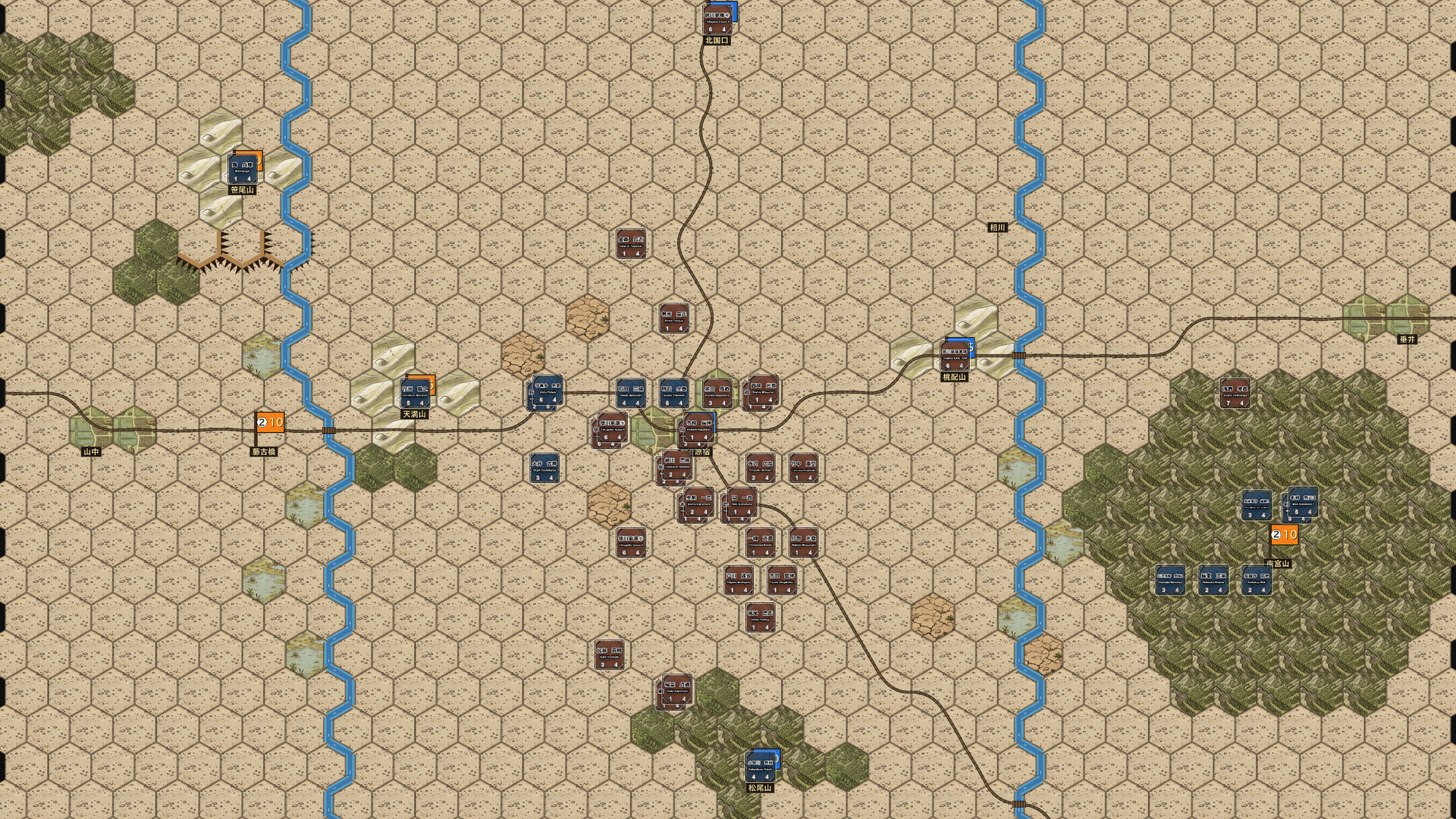
・Sekigahara, 1600 - The battle the game is named for. The 28,000 Mori troops on Mount Nangu stay where they are only for as long as they are held in check. The Kobayakawa on Mount Matsuo change sides from noon. How far can the Eastern Army push before the defection, and how much can it spare to watch Mount Nangu? Can the Western Army hold its crane's-wing line to the end? (8 turns / 72 counters)
・Waterloo, 1815 - What Napoleon lacked was not men, but the number of orders he could issue at once. The French have 36 counters but can move only 12 at a time, with four places to take at once: Hougoumont, La Haye Sainte, the ridge itself, and Plancenoit at their back. Wellington, for his part, must not only yield nothing on the ridge but also come out ahead in the attrition. (11 turns / 78 counters)
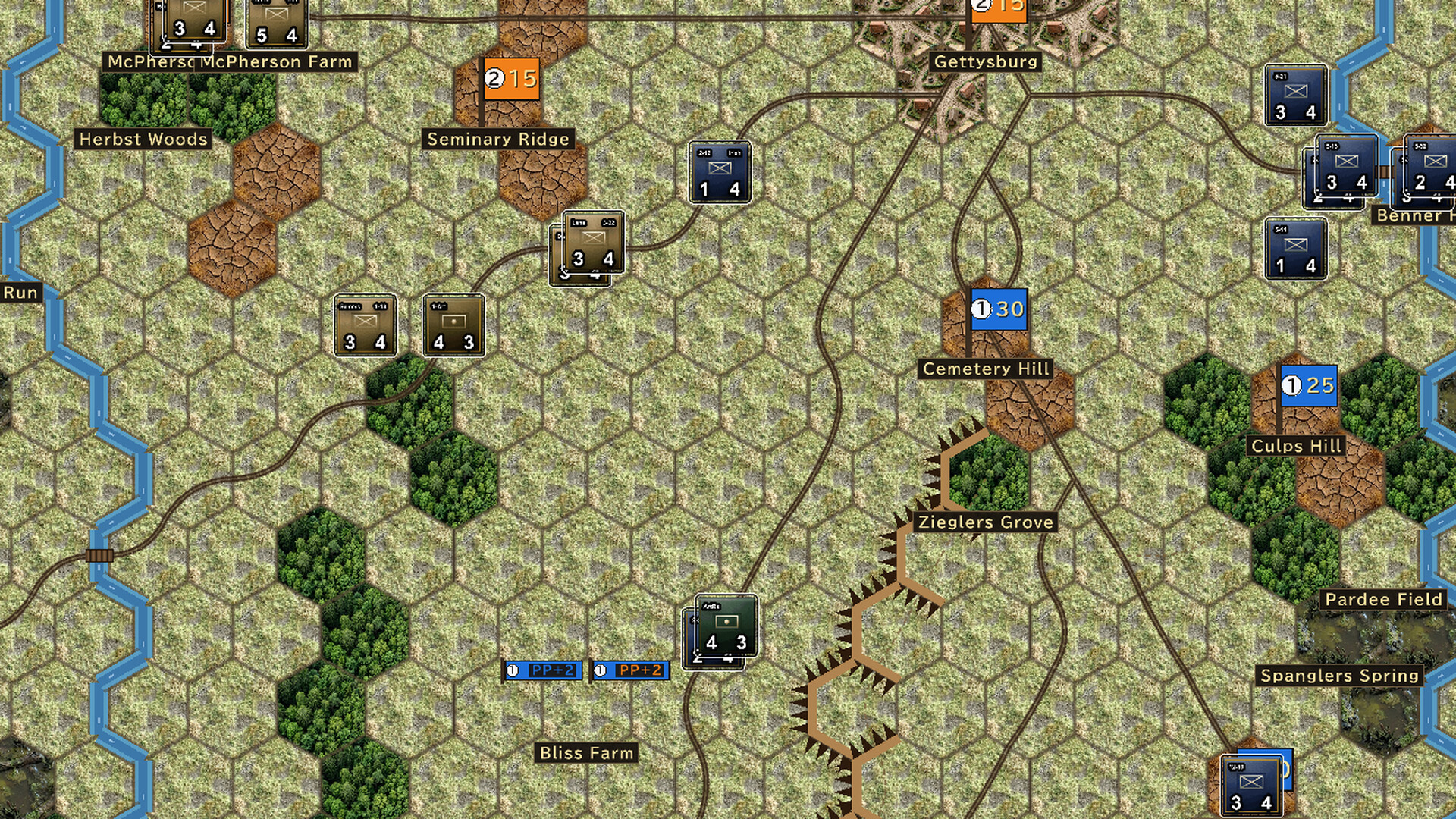
・Gettysburg, 1863 - Three days of battle. The Union holds the fishhook ridge and the short interior line; Lee must work around the long outer line and keep attacking, because standing still does not move the score. Should Howard have gone north of the town? Why did Lee strike the centre again on the third day? (20 turns / 107 counters)
・Chancellorsville, 1863 - The largest field in the game, with each counter roughly a regiment. The battle opens an hour before Jackson's flank attack. The Union has one task - do not give up the crossroads - but can move only 40 of its 227 counters each turn. The Confederates must take the crossroads in the west while a thin line of trenches holds Fredericksburg, ten miles to the east. (10 turns / 374 counters)
Many more battlefields are included.
Deep, but playable in 30 minutes: most battles are decided within 15 to 45 minutes. Only Chancellorsville runs to about two hours.
The free demo includes five of them: Nancy, Okehazama, Sekigahara, Waterloo and Gettysburg.
■ Open the opponent up
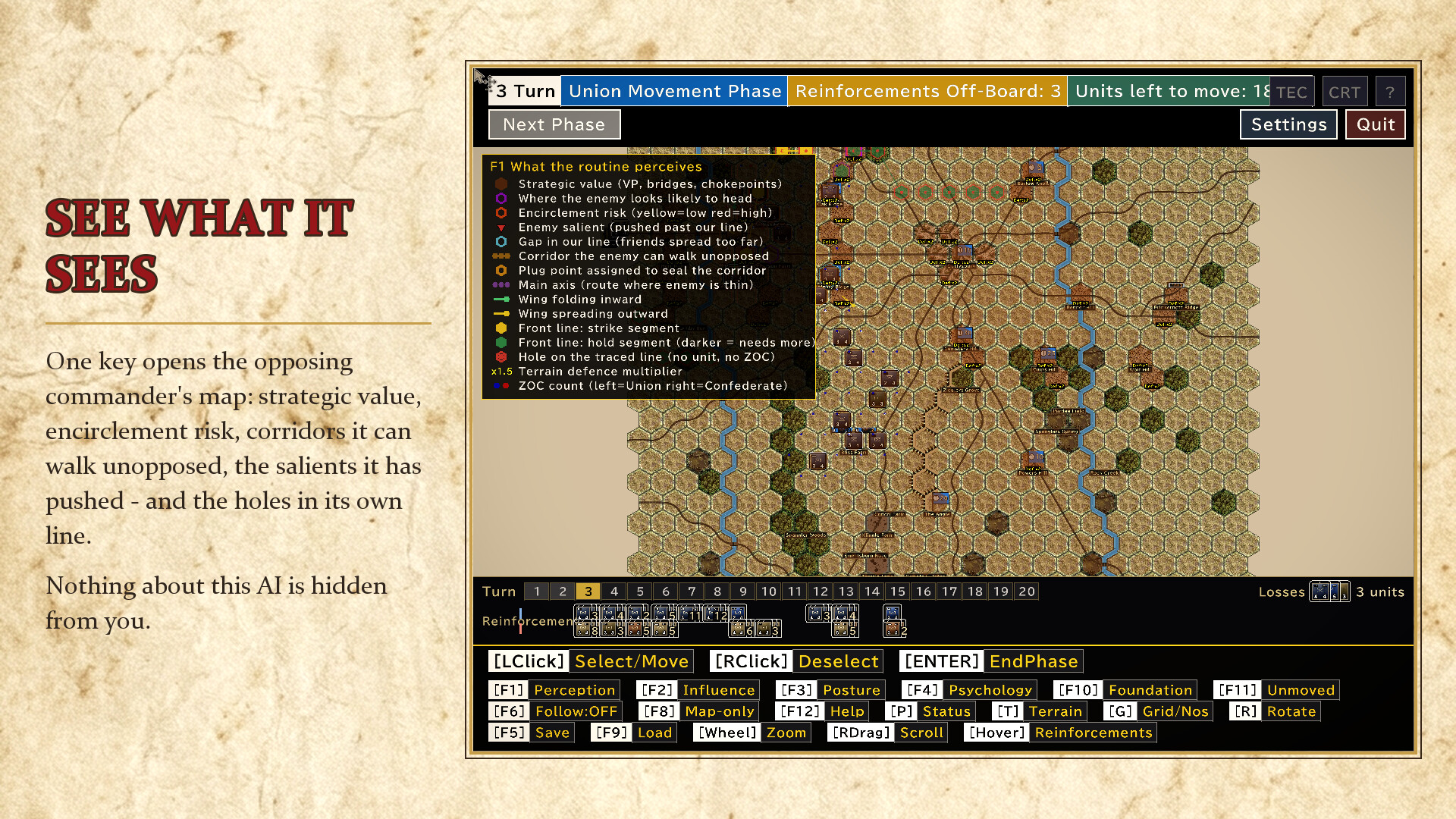
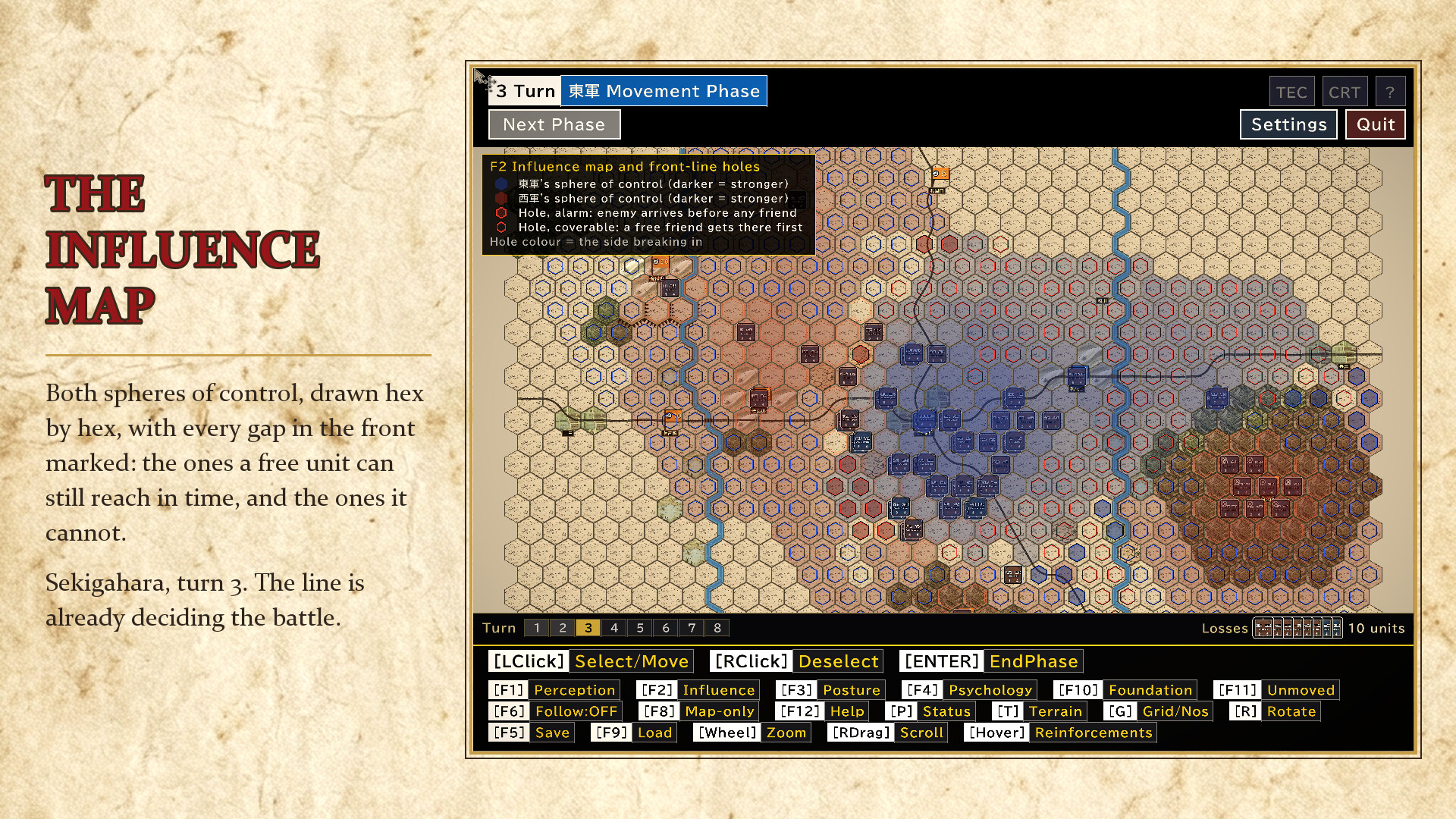
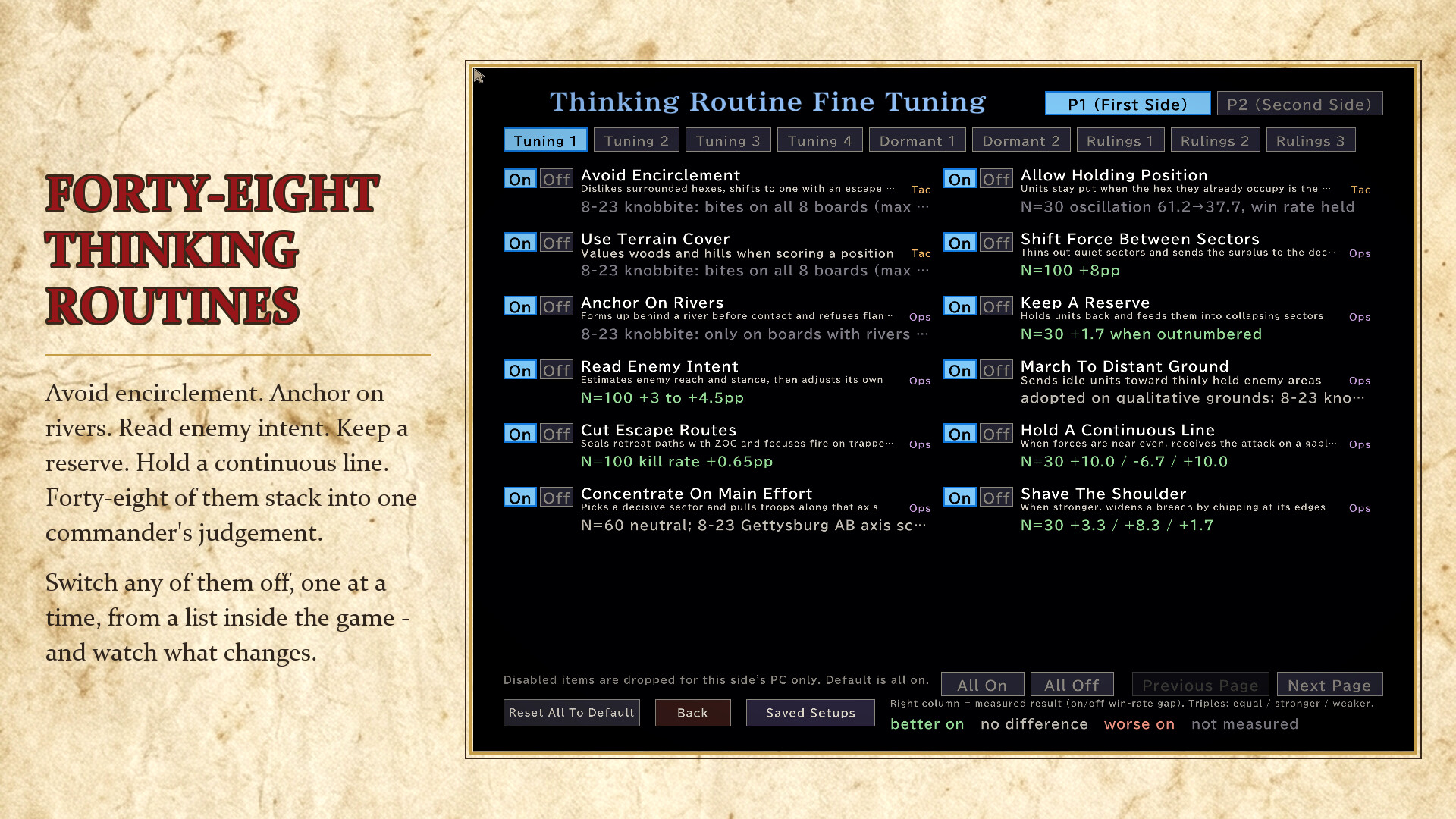
The AI here is not a single block. "Use the river as a defensive line." "Avoid encirclement." "Read what the enemy is trying to do." Forty-eight separate routines stack up into one commander's judgement.
You can switch them off one at a time, from a list inside the game. Build a general who never uses rivers, or one who never reads your intent, and watch what changes. Whatever makes this AI difficult, you can take apart and examine.
There are nine temperaments: standard, defensive, offensive, delaying, manoeuvre, ultra-cautious and seizing - plus relentless assault, and plain incompetence.
■ Build your own battlefields
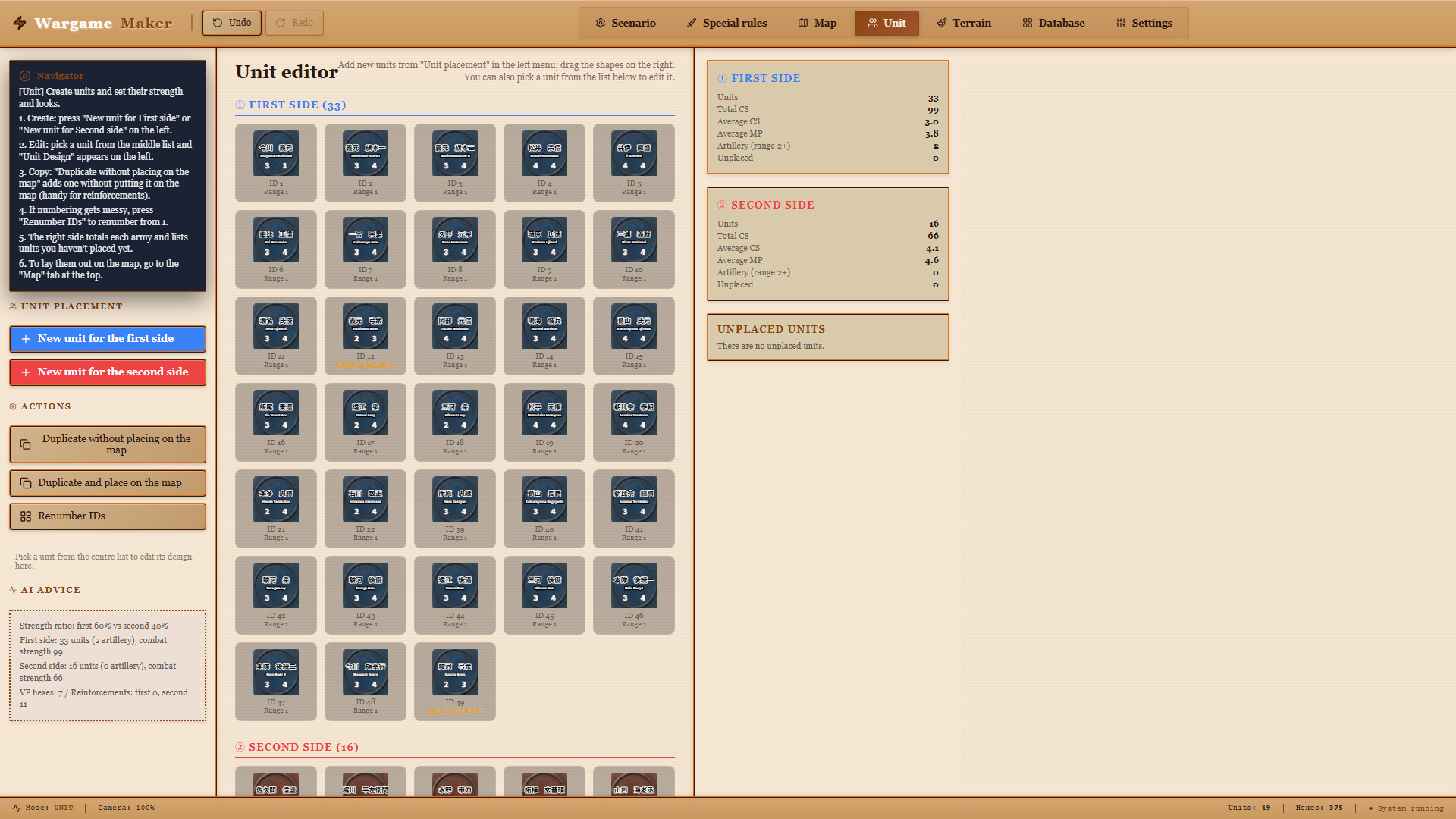
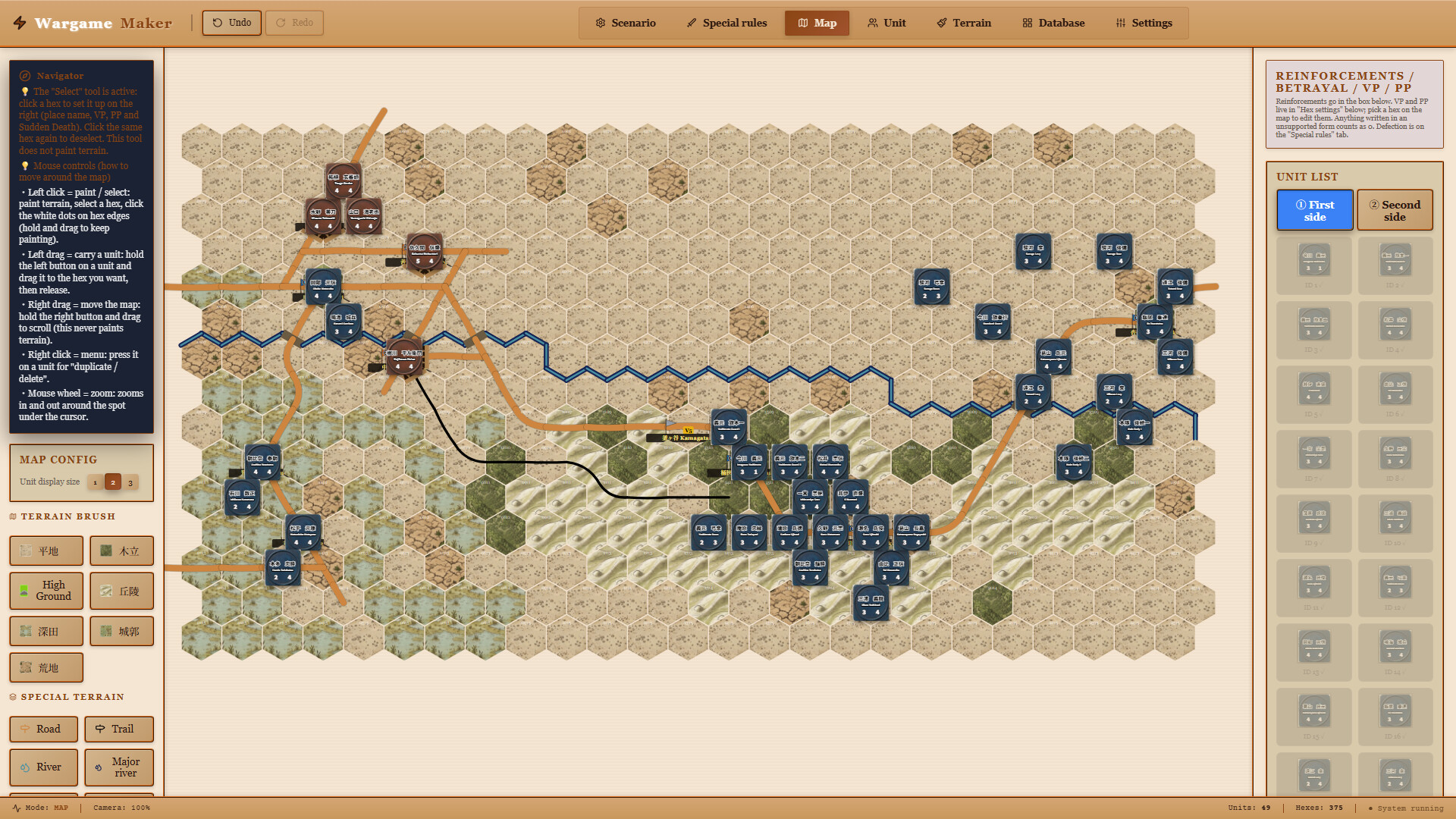
A full scenario editor is included. Lay the hex grid, paint the terrain, run the rivers and the roads, place the counters, set the victory conditions. Every battlefield in the game opens in the same editor, so you can begin by changing the deployment at Sekigahara - and then set the general of your choice against a map of your own.
■ Features
・Mandatory combat - any unit in an enemy Zone of Control must attack
・Combat groups resolve as one-against-many or many-against-one - never a shapeless melee
・Artillery with range and line of sight
・Terrain that decides battles: river crossings, fortifications, ridges, woods, marsh
・Seven-level graded victory, with separate conditions for each side
・Opposing generals with distinct temperaments - from relentless assault to plain incompetence
・Held-back reserves, surprise attacks, sudden-death objectives, reinforcement schedules, defection
・A full scenario editor - modify the included battlefields or build your own
・Interactive tutorial and an in-game rulebook
・Eight languages: English, Japanese, Spanish, French, German, Simplified Chinese, Traditional Chinese and Korean
■ An advisor, if you want one
Hex-and-counter games are not hard because the rules are complicated. They are hard because nothing tells you which of forty legal moves is the one that matters. Ask the advisor and it will show you what it would do and why - or hand it a phase and let it play. Turn it off when you no longer need it.
Available Tables (0)
View available tables...Events Timeline
View full events timeline...Initial Release