Imperium of the Stars


About the Game
Imperium of the Stars is a real-time 4X grand strategy set in a vast procedural Grimdark galaxy. Build an empire, manage the economy, and push your fleets across thousands of star systems.
Factions wage unending war. There is no diplomacy. Remnant systems drift across the stars, worlds that were once part of the Imperium but lost contact when the warp lanes went silent. Now independent, they can be brought back into Imperial rule or consumed by the Void. Play as the Imperium of the Stars, a faith-driven empire rebuilding its grip on the galaxy, or as the Void Eternal, spreading corruption and remaking worlds in the image of its gods. Across the stars, the Grokhar packs fight and pick through the wreckage. More factions become playable over time.
The Game Director governs rival empires and keeps pressure moving across the galaxy from first expansion to final war. No two runs play the same. No downtime. No dull moments.
Key Features
Every faction plays differently - each faction has its own mechanics to manage. The Imperium governs through a court of great offices and rules on faith. The Void Eternal balances the favor of four gods while spreading corruption across the galaxy. The Grokhar build from salvage and prove their Pack-Lord through war and ritual.
More factions, more systems, more to come.No diplomacy. Only war. - factions are permanently at war. Remnant systems, once part of the Imperium, can be reclaimed or lost to Void corruption.
Procedurally generated galaxies - choose your scale, from 1,000 to 10,000 star systems, across a configurable Grimdark galaxy.
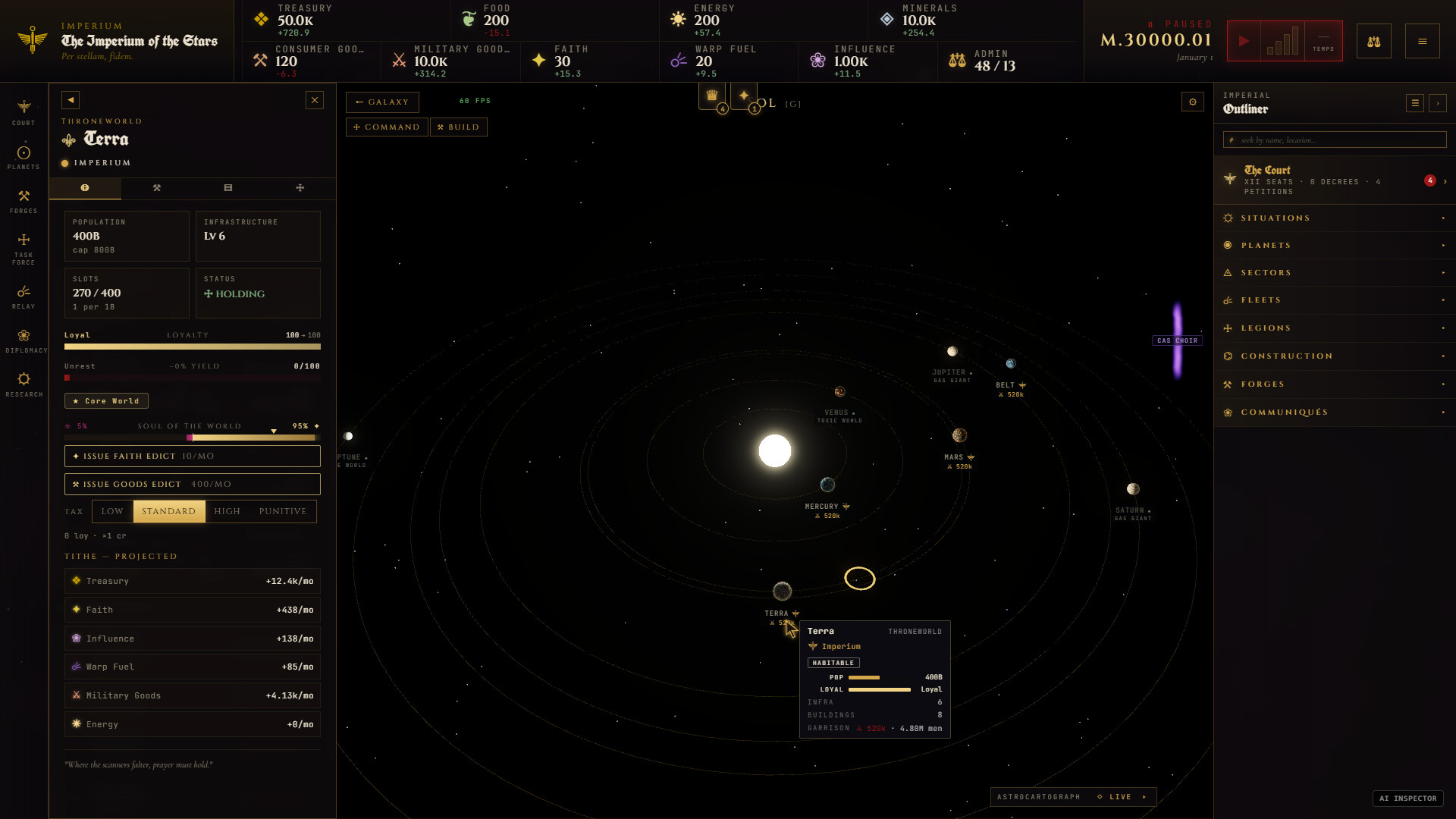
Layered economy - faction-specific resources, per-planet building queues, infrastructure tiers, sector-level governors, edicts, and income deltas broken down to the planet.
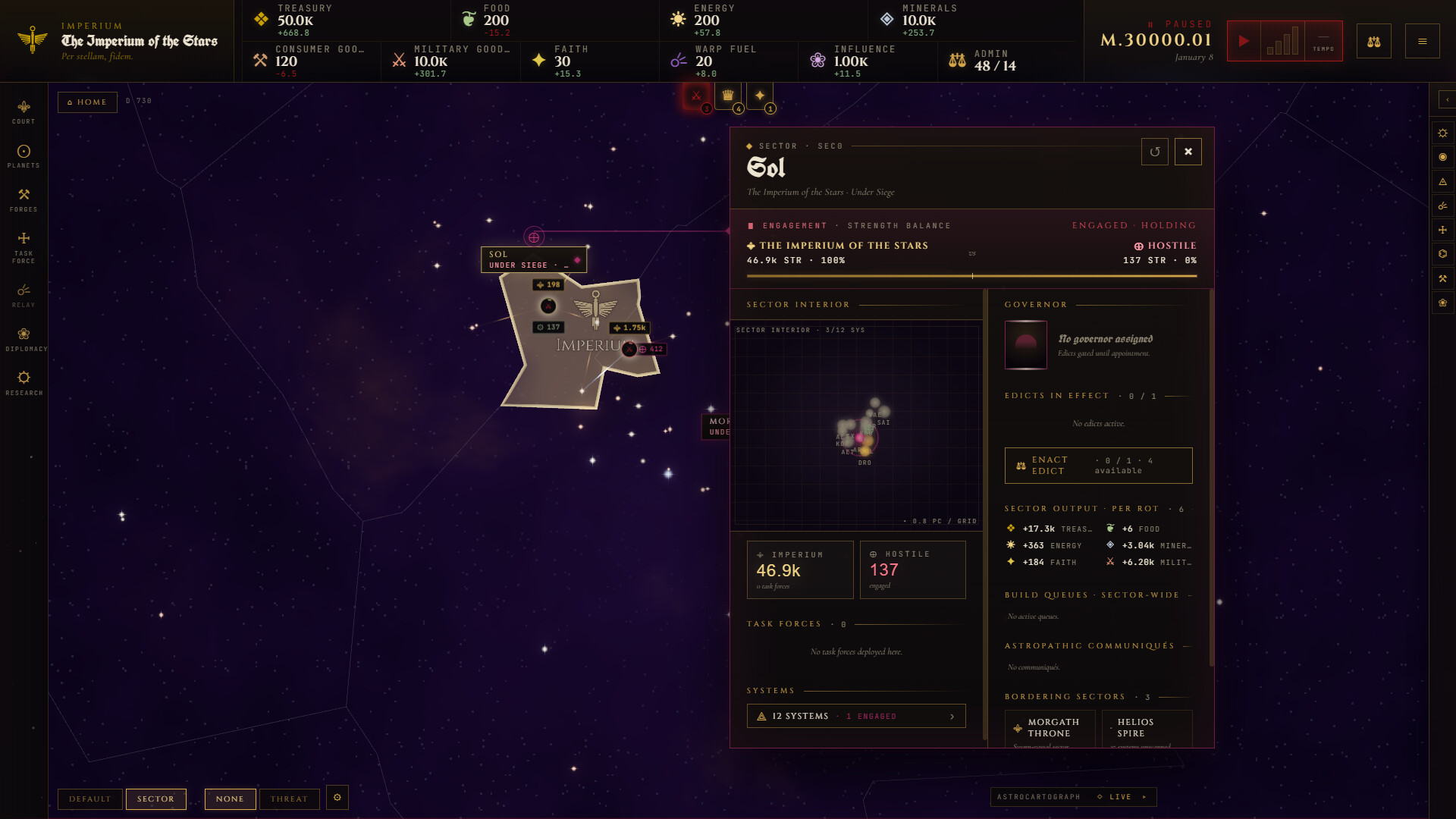
Sector-level command - build and govern at the sector level, and group fleets into task forces that operate across entire sectors. Set priorities, define objectives, and let the task force handle the details. Full control when you want it, high-level automation when you don't.
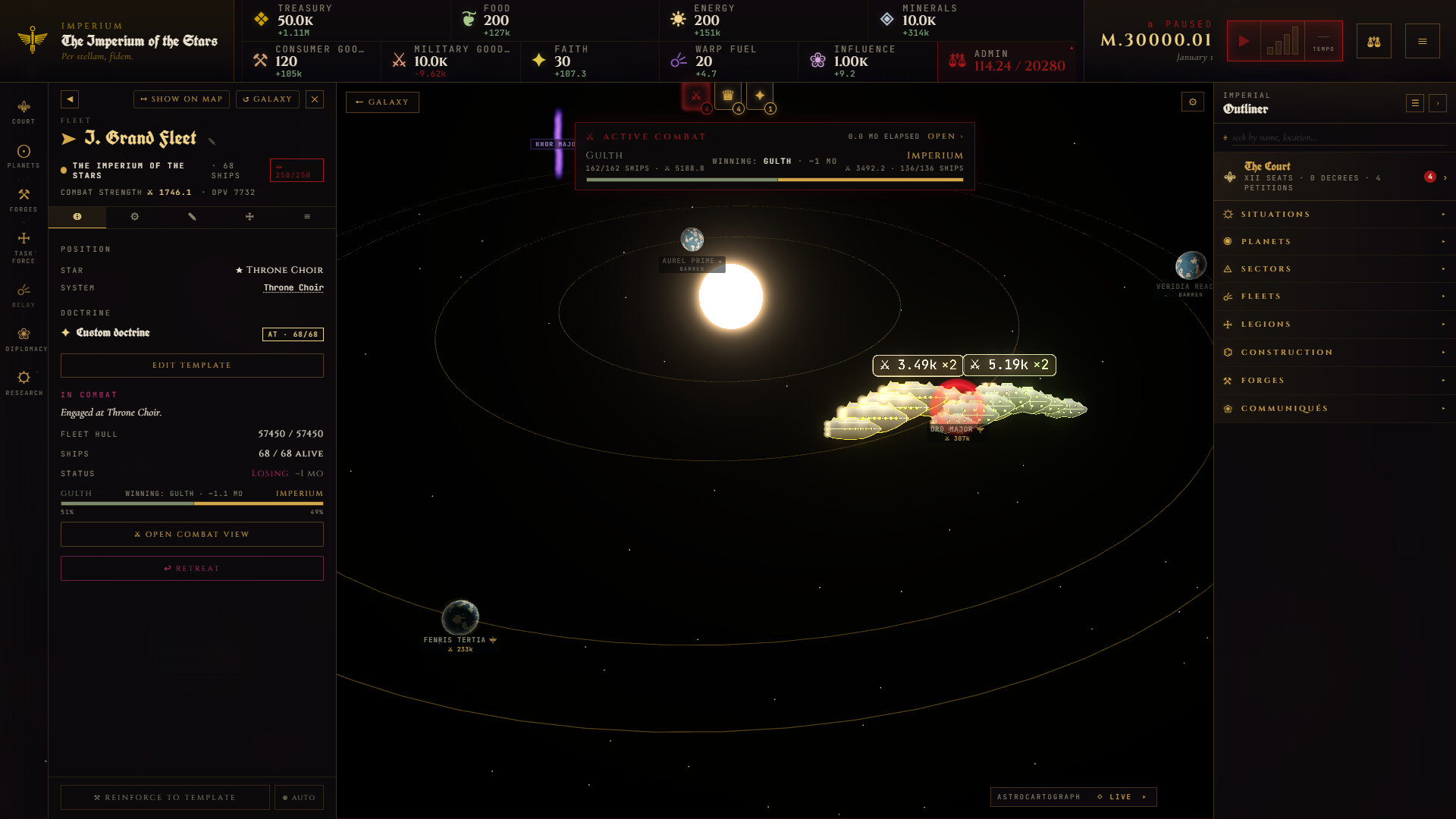
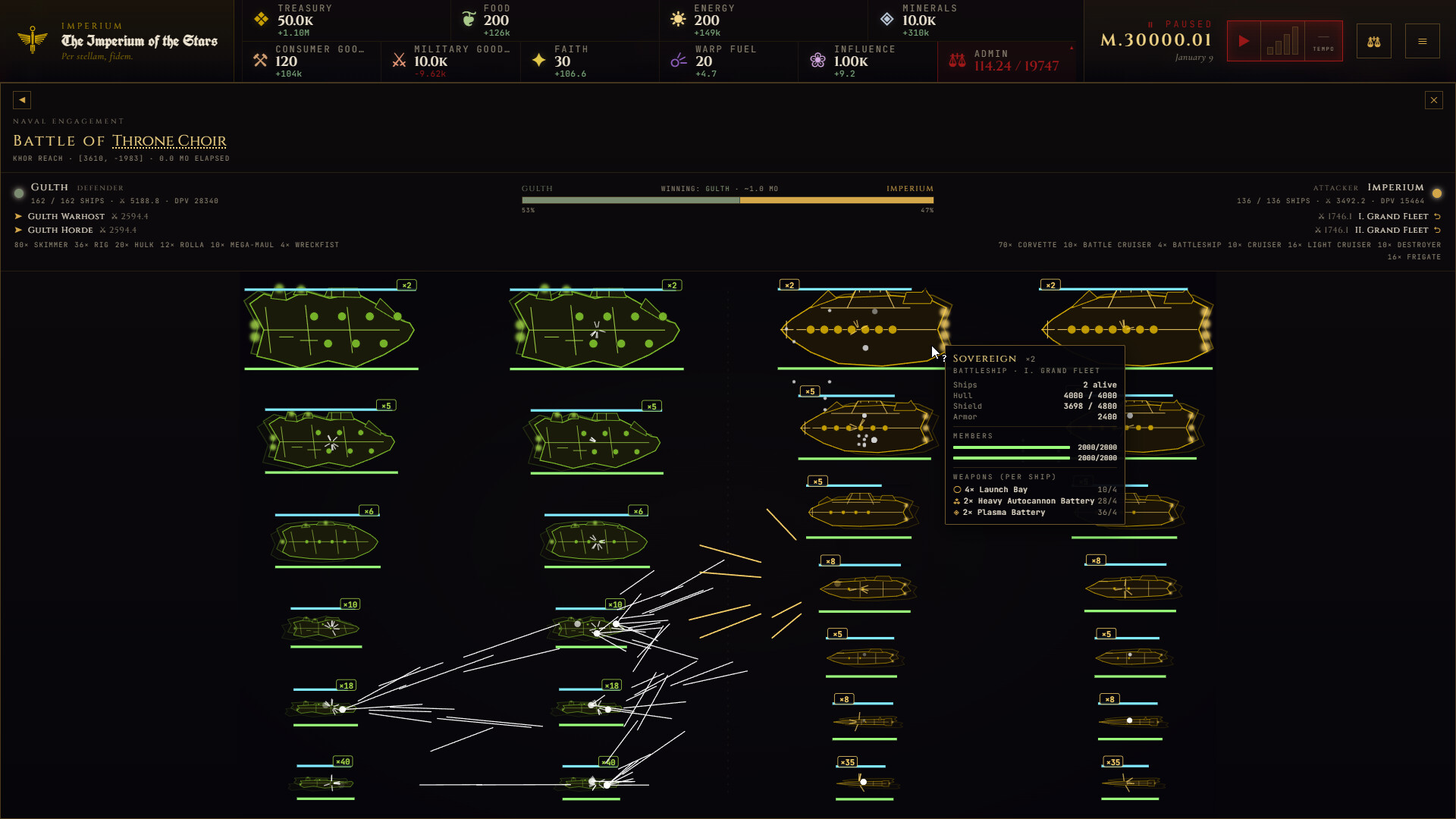
Naval and ground combat - fleet battles between dozens of ship classes, ground sieges with regiment-level warfare, terrain modifiers, and morale systems.
Unique asymmetric tech systems - each faction advances through a completely different research structure, unlike anything in traditional 4X games.
The Ordinator - choose your Game Director: Balanced, Aggressive, Chaotic, and more. The unseen force shaping the epoch answers to you. Change it mid-game whenever the galaxy needs a different hand.
The Factions
The Imperium of the Stars
A hierarchical faith-empire that has ruled ten thousand worlds and intends to rule ten thousand more. The Eternal Throne governs through a court of great offices: Warmaster, Cardinal, Forgemaster, Admiral and more, each holding a seat of power. Appointed Governors administer each sector. The Choir is the Imperium's warp infrastructure. Synchronized collective faith has real, physical effects on the warp, and the Choir exists to harness that at scale. It looks like a church. It functions like a utility grid. It operates like a military. Faith is not just belief. It is infrastructure.
The Void Eternal
There is no name for what they are. That is the first verse. The Void Eternal invades and conquers like any empire, but where the Imperium builds on faith, the Void runs on corruption. Worlds are not merely occupied; they are remade. Four gods move through the Void: the Hollow Moon, lord of entropy and erasure; the Carrion Choir, voice of slaughter and endless war; the Unwritten, who rewrites warp lanes and unmakes maps; and the Glutton Below, who devours worlds whole. Balancing their competing hungers shapes every decision you make.
The Grokhar
Multiple packs, each with its own lord, its own iron, its own way of making war. They build from what others die in, salvage stripped from wreckage, hammered into crude weapons that work because they have to. At the heart of every pack is the Pack-Lord, and the Lord must be proven. Through war, through ritual, through blood. A pack whose Lord grows weak falls apart. A pack whose Lord is strong takes everything.
Beneath the violence, something older listens. The hive-whisper. The spore-mass. The packs don't always understand it. They follow it anyway.
The Galaxy
Before the first fleet moves, you shape the galaxy. Choose your scale, from 1,000 to 10,000 star systems, then set your scenario and choose your Game Director. The Ordinator, the unseen force shaping the epoch, answers to you. You decide the pace and pressure, and you can change it mid-game. Dial it up, pull it back, and the galaxy responds.
Rival empires expand, remnant systems rise and fall, crises come in without asking. There is always a situation demanding attention, always a fire somewhere on the map. And when the last system finally falls, the game does not end. New threats emerge. You decide how long you play, and how hard you want it to be.
Situations and Events
The galaxy doesn't wait. Story events surface without warning: a Cardinal's petition, a Void whisper taking hold on a frontier world, a faction situation demanding a call right now. Some resolve in a single decision. Others escalate over months into something much harder to contain. A galaxy-wide crisis can shift the balance of power overnight. And faction situations cut deeper: gods grow restless when neglected, courts fracture when unattended, Pack-Lords grow bold when they go too long without blood.
Other 4X games give every faction the same tools with different numbers. This one doesn't. The Imperium's court, the Void's gods, the Grokhar's Pack-Lord are not flavour. They are the game. The Ordinator is yours to configure. Some players want constant tension and rivals that never stop pushing. Others want to build at their own pace and pick their fights. Choose your Game Director before you start, change it whenever you need to. The galaxy responds to what you ask of it.
Economy and Buildings
The economy runs at every level. Planets generate resources, house populations in the billions, and run their own building queues. Buildings unlock at infrastructure thresholds, scale through upgrade tiers, and feed into sector-level accounting. Appointed Governors manage each sector, pooling and redistributing resources across their worlds. Edicts issued at sector or empire level layer further modifiers on top.
Faith and loyalty are resources too. A world with falling loyalty bleeds output and invites unrest. Faith sustains the Choir, enables edicts, and holds the Imperium's grip on distant systems. The spiritual health of your empire is as important as its ledgers.
Combat
Naval battles pit fleets of cruisers, battleships, destroyers, and capital ships against each other. Weapons range from autocannons and lance arrays to torpedo salvos and launch bays. Ground warfare runs through regimental armies of infantry, artillery, armour, and recon battalions, with planet type shaping the fight. Fortress Worlds give defenders heavy armour. Sprawl Worlds turn every district into a kill zone.
Ten thousand worlds. One throne. The void is patient.
Available Tables (0)
View available tables...Events Timeline
View full events timeline...Initial Release