Alphabetto's

About the Game
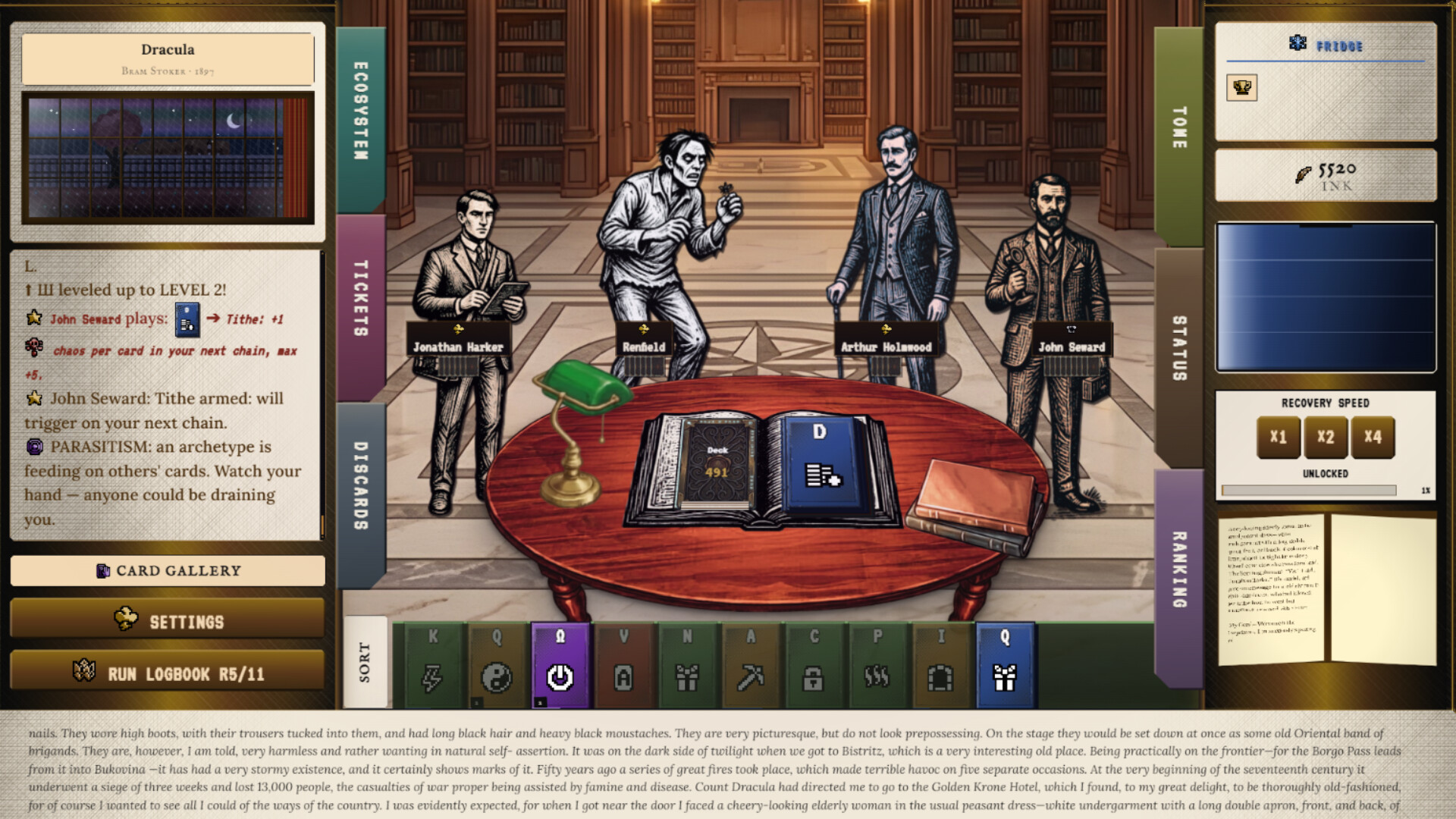
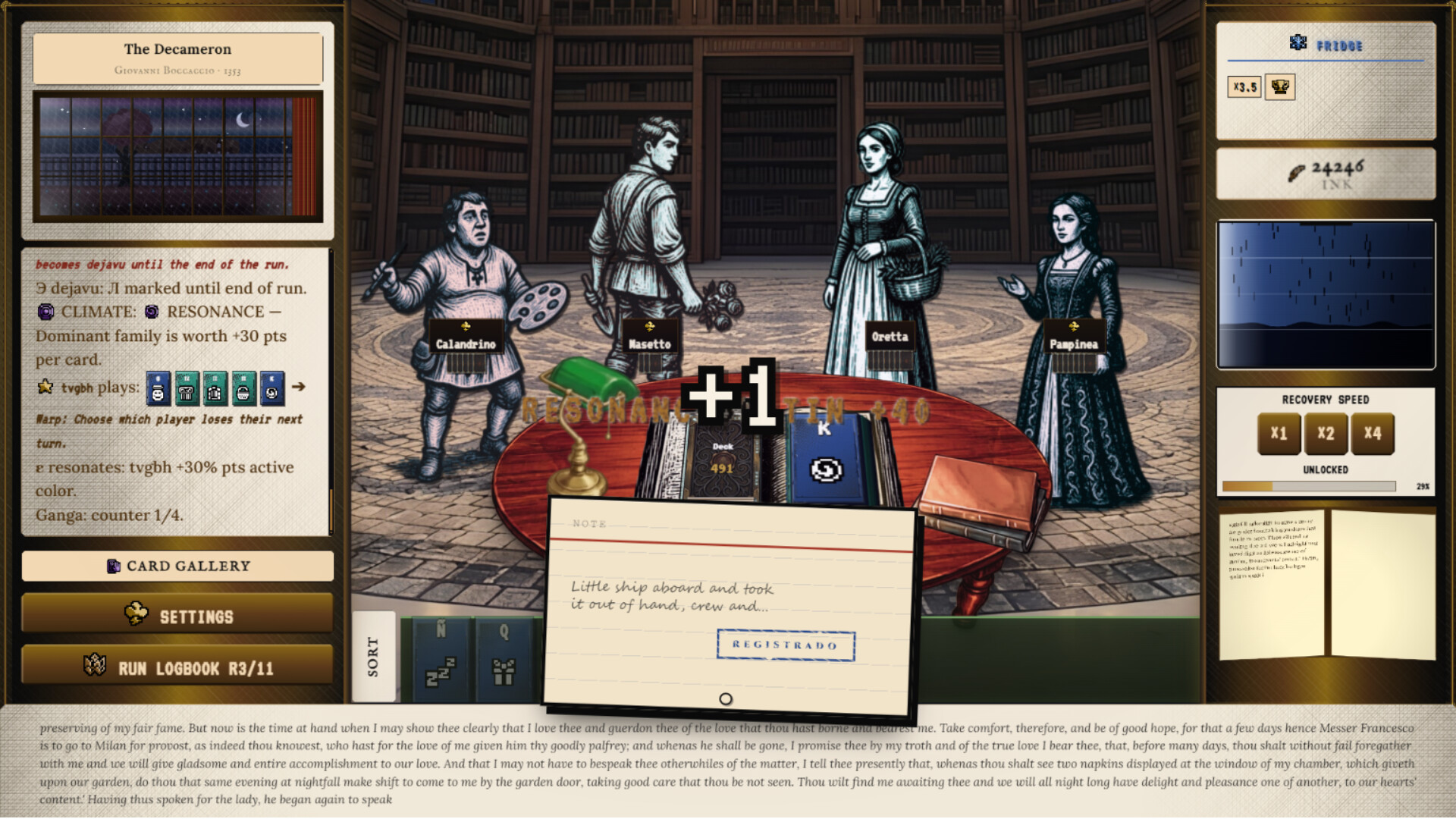
At night, in an empty library, the characters of the great classics sit down at your table. They haven't come to chat. They've come to gamble the only thing they have left — that tomorrow, someone still remembers them.
Alphabetto's is a roguelite deckbuilder made of letter-cards. Here, every hand you win is a line of their book brought back into existence, a page that isn't forgotten, a book that doesn't die.
There is no "your deck" and "the rival's deck". There is one deck, and everyone plays out of it. Every card you add to your collection might win your next game — or land in a rival's hand and blow you apart. Interested in that rare card with the brutal effect? Then you have to put it in the deck. But it will also be sitting there for whoever takes the chair across from you tonight.
Build with a cold head, knowing your best weapons can just as easily become theirs.
When you win a night, the game puts the card you played most in front of you — and the chance to leave your mark on it. You draw that signature by hand, your own stroke. And the card goes back into the deck, everyone's deck, because there is no other one, with your signature on it.
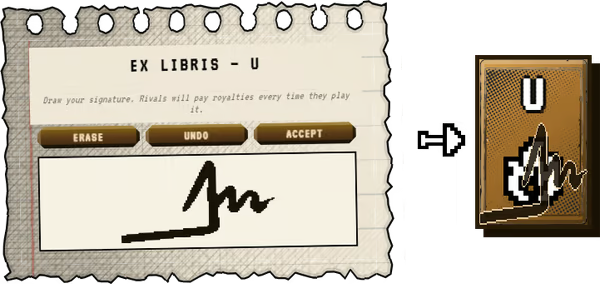
From then on it's yours in a strange way: it keeps circulating, it keeps landing in other people's hands, and every time someone plays it against you they pay you fifty ink. Your mark turned into a toll. The better the card you signed, the more they'll want to use it — and the more often you get paid.
The signature doesn't wash off when the game ends. It stays on that card forever, run after run, and you'll find it in a rival's hand months later.
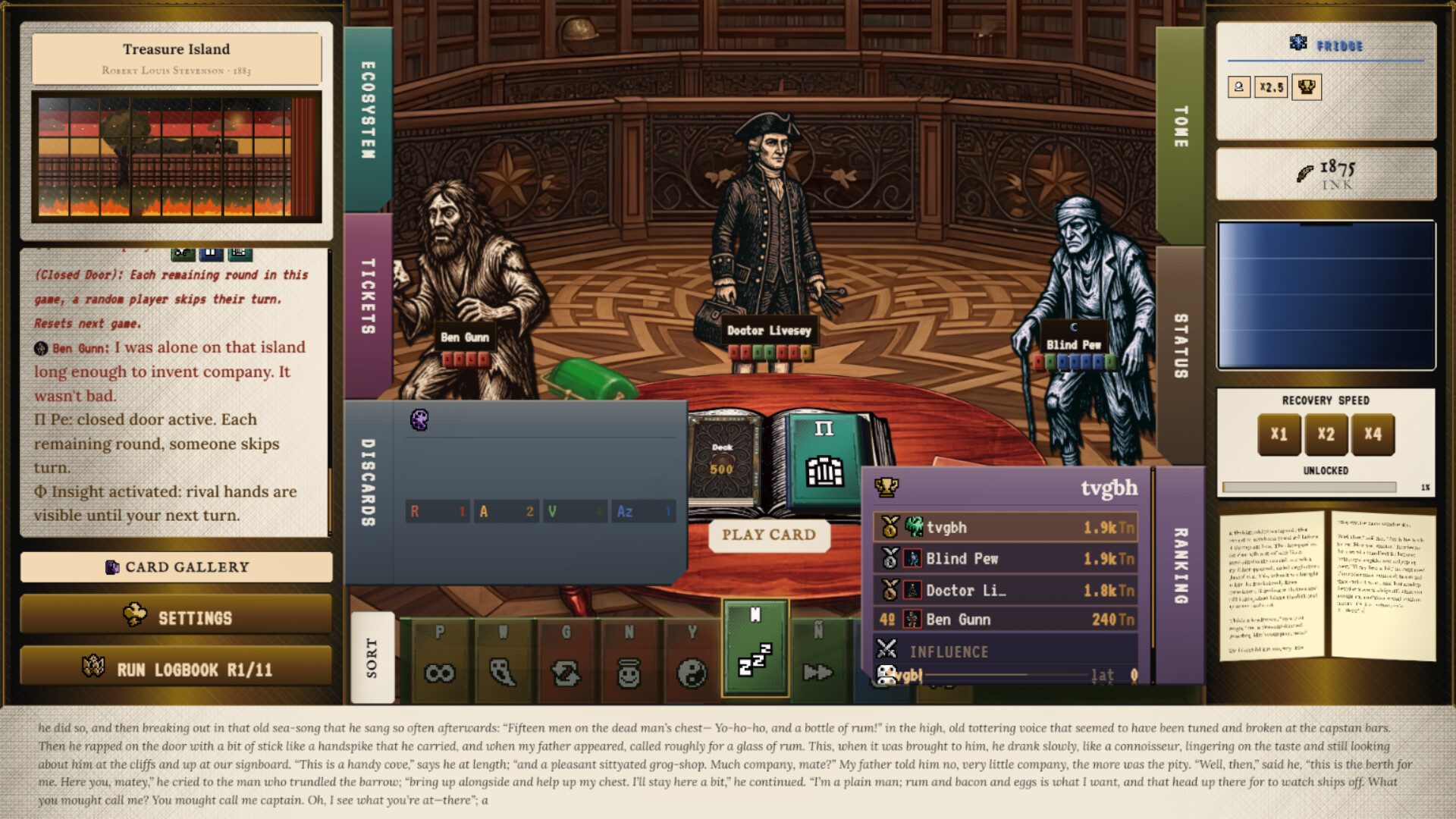
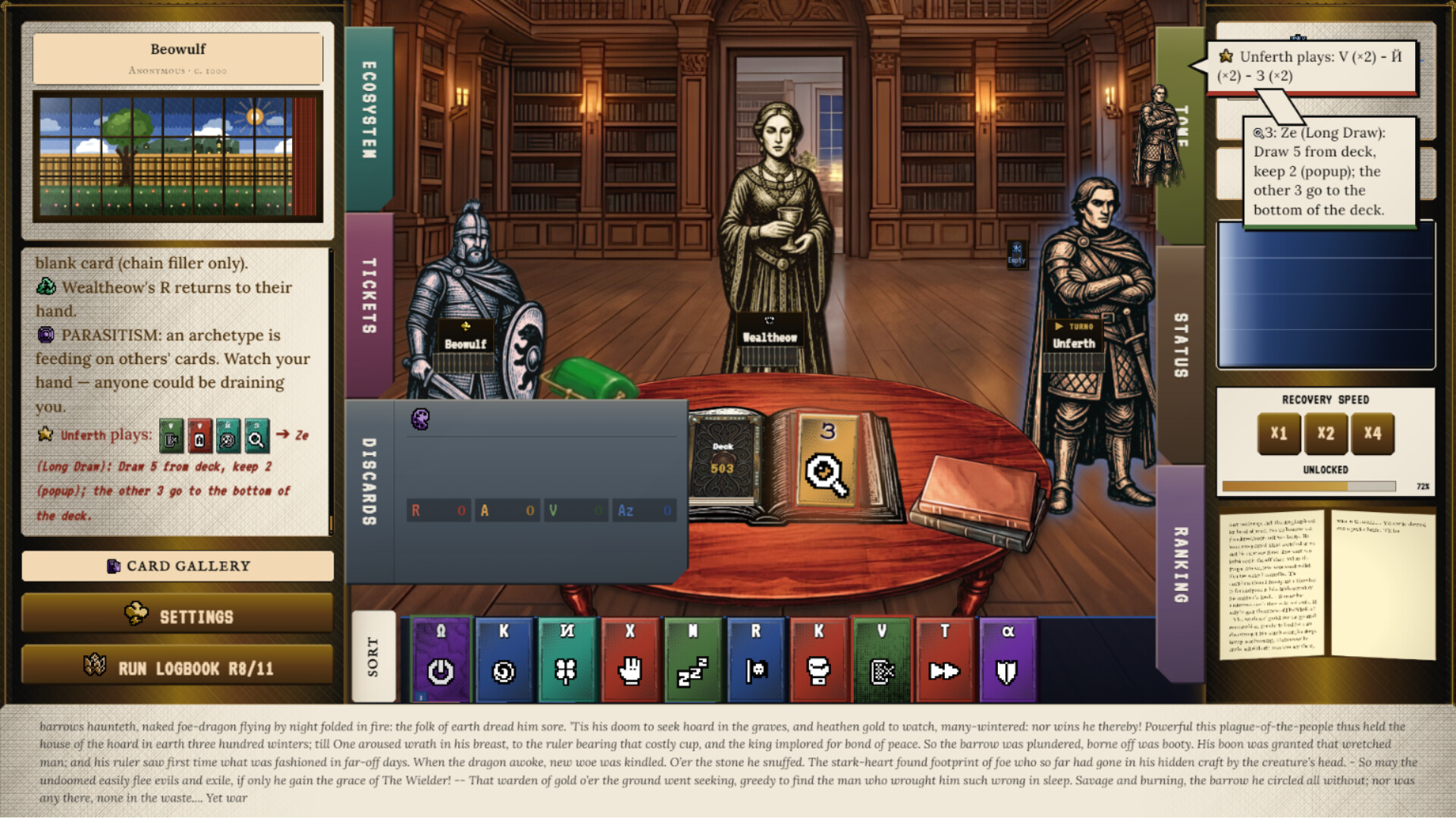
Your goal is to be the first to get rid of every card in your hand. The fastest way is firing off chains of cards on your turn. Chaining letters works under two rules so simple you learn them in thirty seconds.
Same colour, in alphabetical order: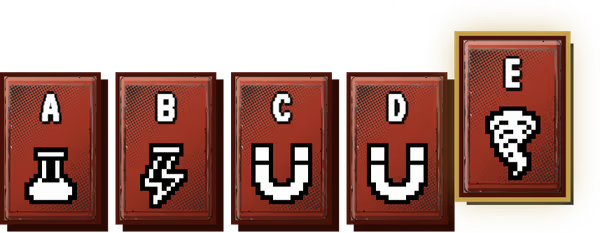
Or the same letter, in different colours — and watch out, because the same letter does something different in every colour:
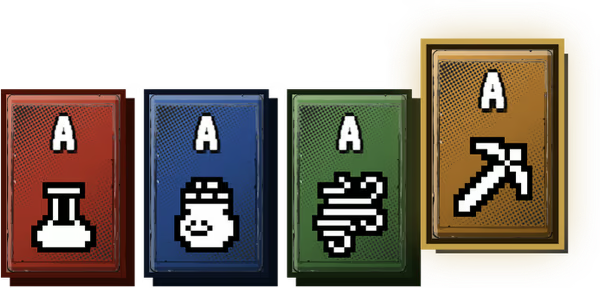
You stretch a chain with wildcards, Greek letters, Cyrillics and character cards — and here is the strategic part: [b]the last card you place is the one that fires its rule[/b]. So you choose which card closes your chain, and in choosing it you choose which effect detonates next. One decision per play. A combo tree with no bottom.
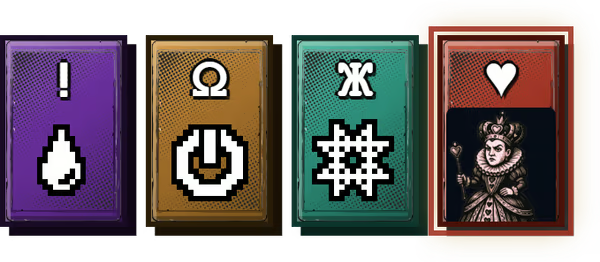
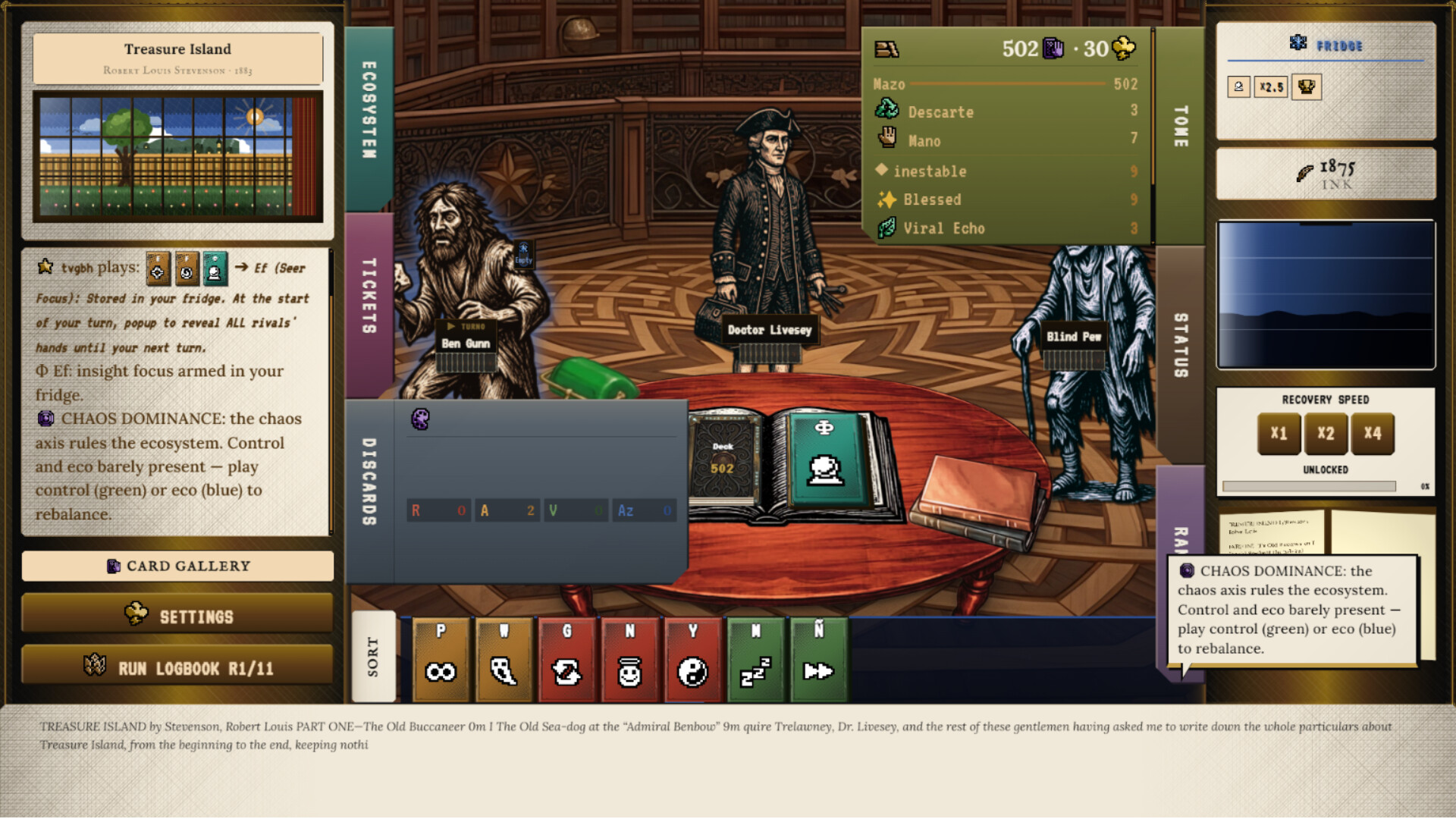
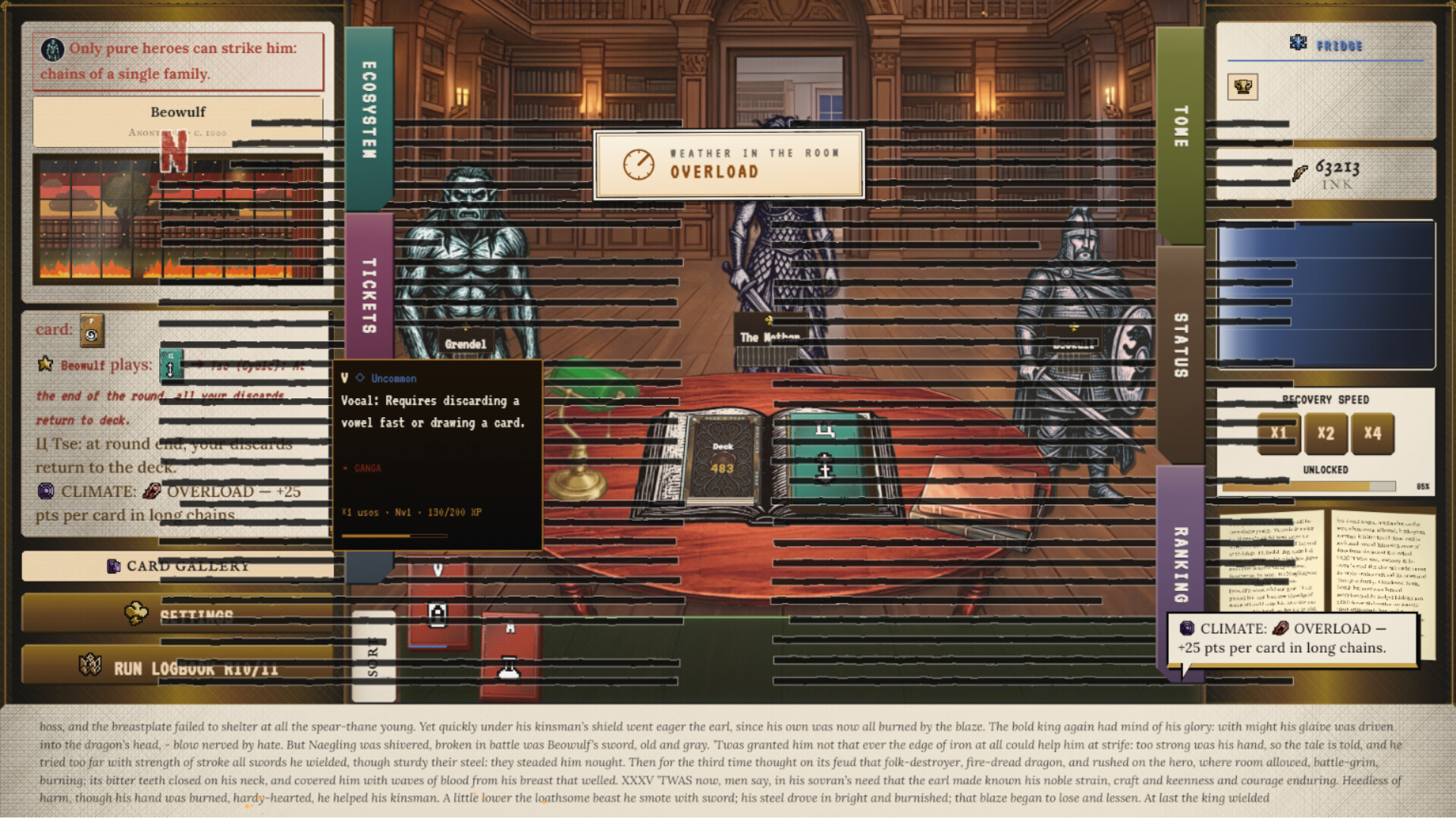
Every card belongs to a family — those of breath, of the body, of mystery, of emphasis, the nameless ones. Each game, the cards that get played most push their family towards dominating the ecosystem. And the way you interact with the ecosystem, in turn, triggers different climates.
You also have to watch the deck's temperature: it rises with chaos, it falls with eco. When the table heats up it enters Pure Chaos and the temperature doubles on its own; at white heat the Chaos Singularity fires and cards start mutating inside the deck.
And above all of it, the global events:
The Infection, which poisons the deck.
[The Fracture, which breaks cards when the deck is replenished.
The Ecosystem Collapse, which devours the deck in corruption.
One more resource to master: investments in the ecosystem. Buy consumables at The Index to heat the table and accelerate the climates, or to cool it down and stabilise the start of the next round.
And at the key moments of a run you decide which path to take. From the map you choose whether to walk into an encounter with rivals or go through some other kind of event — shops, lecterns to upgrade your cards, loose pages where you pick a card to add to your deck... But remember: everything you add to your deck, the rivals at the table inherit too.
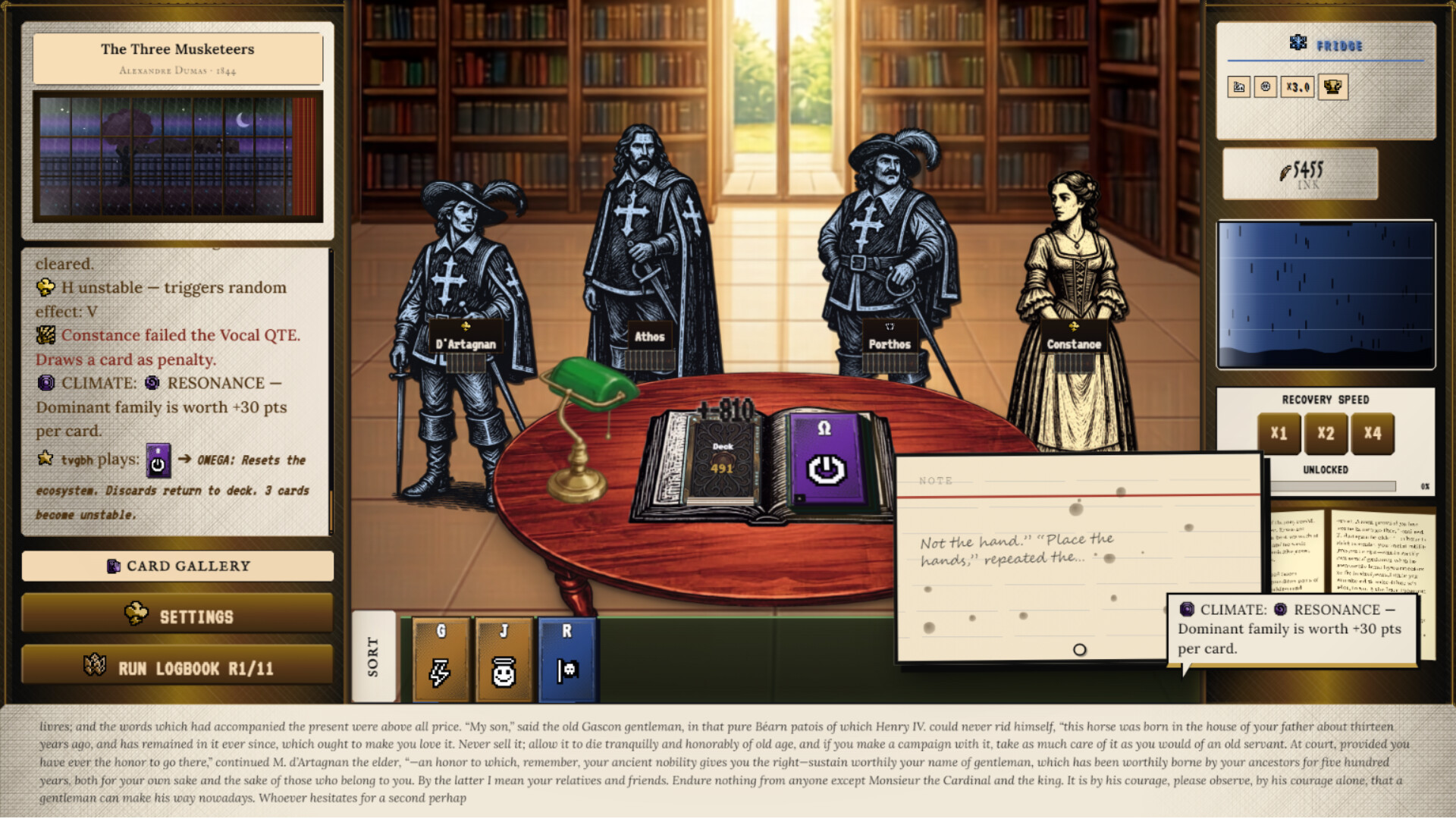
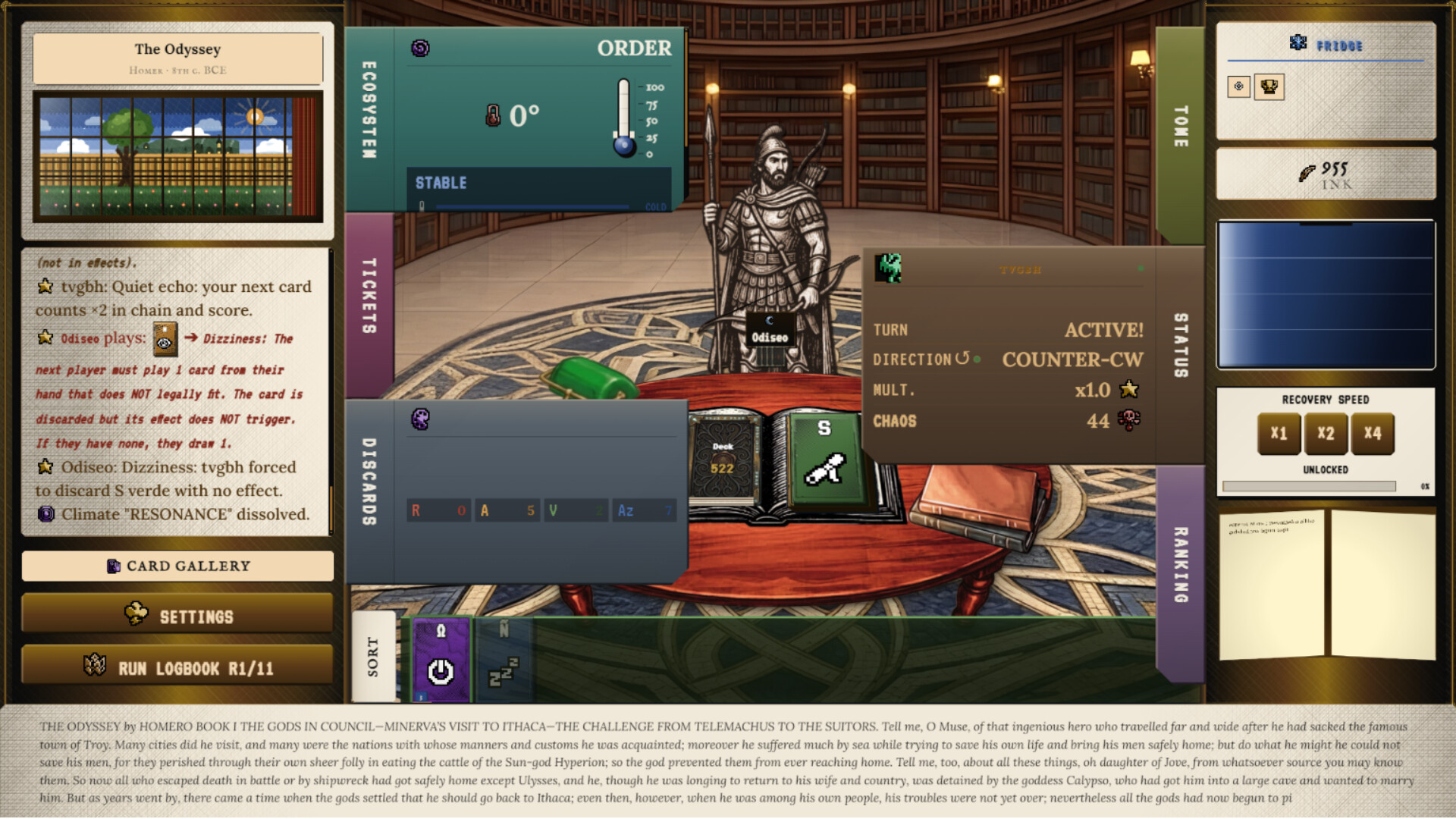
Alice, Dracula, Hamlet, Frankenstein, Don Quixote, Lazarillo de Tormes, The Odyssey, One Thousand and One Nights, Journey to the West, Beowulf, Carmilla, Candide, Fuenteovejuna, The Monk, Robinson Crusoe, Faust, La Celestina, The Three Musketeers, King Solomon's Mines, Gulliver's Travels, The Wizard of Oz, The Jungle Book, Ramayana, Les Misérables, The Decameron.
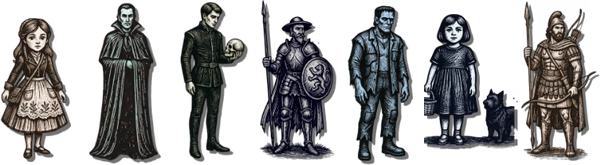
Twenty-five works of world literature — the ones everyone should read at least once in their life — opened up as soundtracks, bosses, character cards and relics, all at your disposal so you can help preserve the most important thing they have left: staying in your memory.
The works in the library don't arrive all at once. They unlock line by line, in ink, on the playing table. The more you play a book, the more of its text appears — real lines from the original, written by your hand of cards. And when the night is over you can open the library catalogue and sit down to read what you have restored.
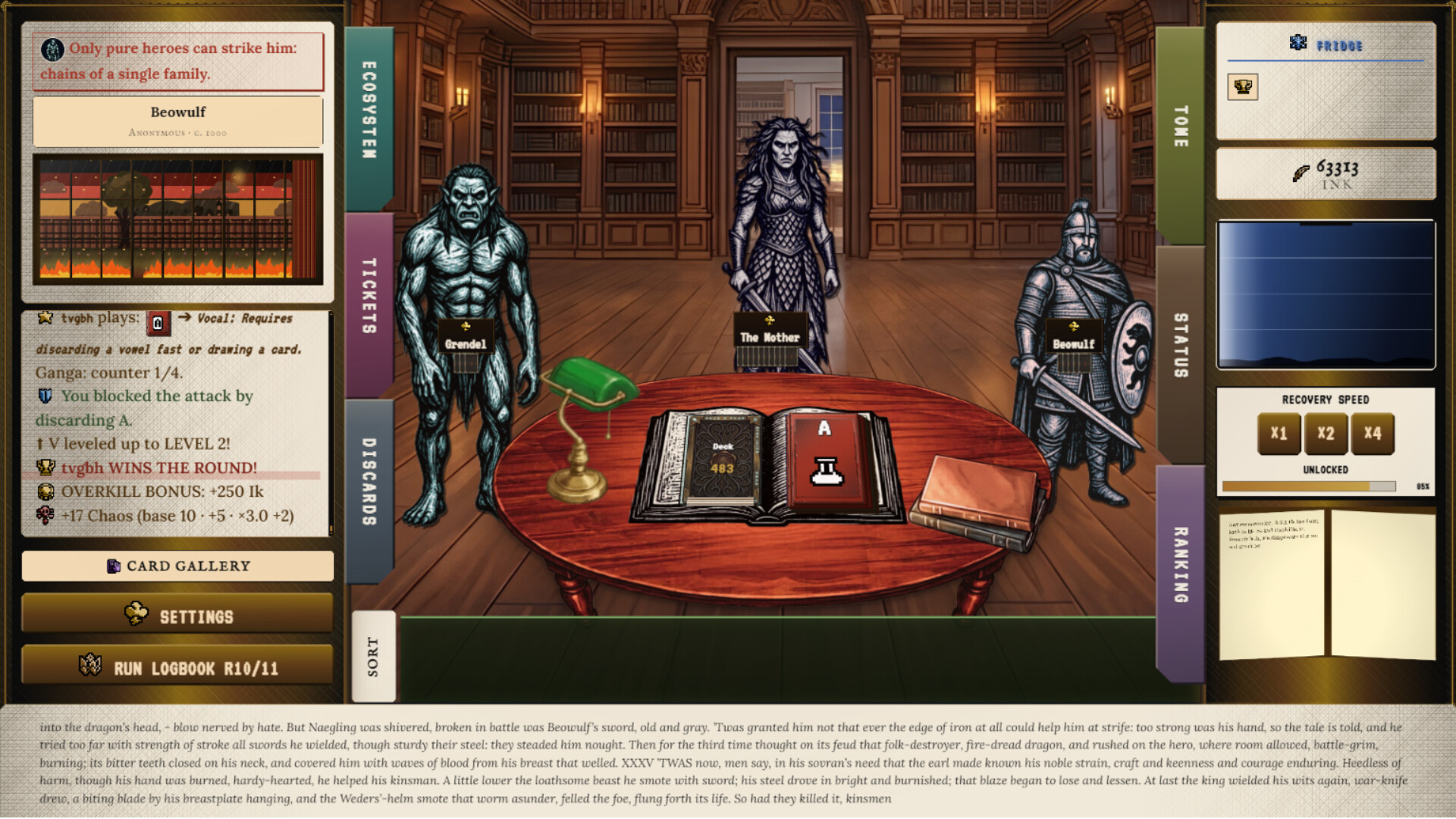
25 unique bosses, with special mechanics and a different personality every time they visit you. One erases your vowels. Another forbids an entire colour. Another chains your plays to whichever family dominates the ecosystem at that moment. Another copies your own archetype and turns it lethal against you. They aren't beaten with brute force: they're beaten by working out which rule of the world just changed — and why that one in particular.
The clock in the entrance hall has been showing the same time for a while now. Sometimes, between one game and the next, you find notes in the margins you don't remember writing.
The game doesn't explain. The game suggests. You decide what you think you saw.
Roguelite + deep deckbuilder with real persistence between runs.
A deck shared by everyone at the table — every card you add can win you the game or win it for a rival. Your own deckbuilding is the thing you have to face.
Signature mechanic: sign a card and collect royalties whenever rivals play it.
A chain system with two rules and a closing decision that opens an endless combo tree.
Card families + a living ecosystem — each game, the cards that dominate push the ecosystem in one direction.
Deck temperature that rises with chaos and falls with eco; at white heat the Chaos Singularity fires and the deck starts mutating on its own.
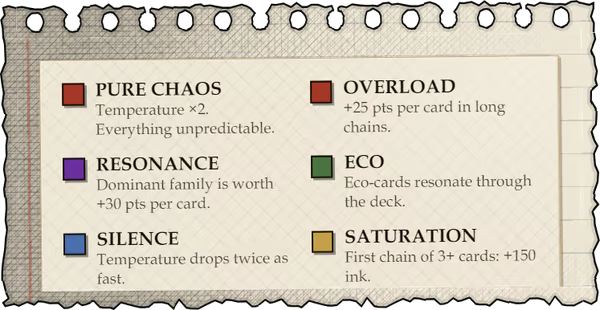
Six dynamic climates — Resonance, Saturation, Overload, Silence, Eco and Pure Chaos — that rewrite the table according to the state of the ecosystem.
Global events: Infection, Fracture, Collapse. They change the flow of a run when certain thresholds are crossed.
Global draft at key moments: you pick a card for the ecosystem. Everyone inherits it.
Ecosystem investments from the shop: heat it, cool it, tame it.
Sign, fuse, graduate and mutate your cards: every slot in the deck grid is a build decision.
25 unique bosses that rewrite the rules of the table instead of inflating health bars.
25 great works of world literature spread across 7 sections that unlock as you advance.
A library catalogue where the works write themselves line by line — unlock the real text of the originals — through victories.
An original soundtrack of 68 pieces, from the soft jazz of the reading room to the dense gothic of the forbidden section.
Narrative layers revealed in notes, fragments and ambiguous events — the game never tells you what to believe.
Multiple endings. Reaching the first one is already hard. Finding the last one changes what you thought the game was.
Spanish and English.
100% offline.
Every card, every effect, every speech bubble, every note lost in a lending file has been designed, written and assembled by one single person. If something you've seen here got to you, add Alphabetto's to your wishlist. Every wishlist is one more chair at the table.
Available Tables (0)
View available tables...Events Timeline
View full events timeline...Initial Release